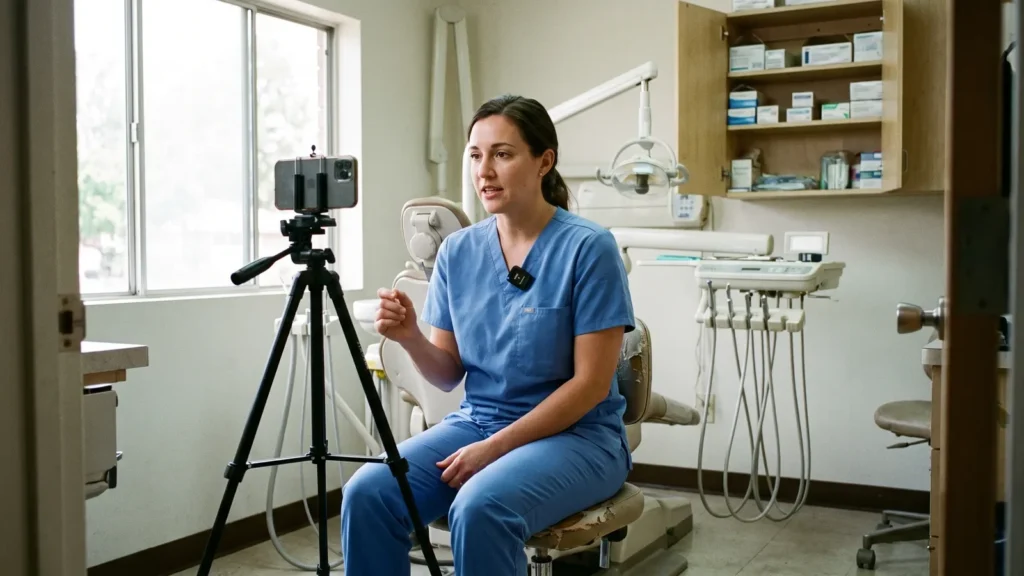
Explainers, attorney intros, FAQ answers, process walkthroughs, and community or CLE clips build trust without triggering testimonial and past-results rules. Each states facts about your practice, not outcomes, and each can carry required disclaimers on screen.
Why law firm video is a compliance decision before it’s a creative one
Your state bar reads a short vertical clip the same way it reads a billboard. If the content promotes your services to prospective clients, your bar will generally treat it as an advertisement, which brings retention obligations and required disclaimers; a minority of states — Texas and Florida among them — also require filing. The camera setup is the easy part.
Deadlines are short and they are enforced. In Texas, a lawyer must file an advertisement with the State Bar’s Advertising Review Committee no later than ten days after the date it is disseminated, according to Rule 7.04 of the Texas Disciplinary Rules of Professional Conduct. A missed window turns a marketing asset into a grievance exposure.
Decide the compliance path before anyone writes a script. Pick the rule the video falls under, name the partner who signs off, draft the on-screen disclaimer, and choose where the archived master file lives. Firms that skip this step shoot everything twice.
Your creative options narrow, but they do not disappear. Five formats do real trust work while staying inside the lines, because none of them depend on client opinions, case outcomes, or staged events.
The five video types that build trust inside the rules
Trust in legal marketing comes from demonstrated competence and clear expectations, not from enthusiasm. A prospective client watching an estate planning explainer is checking whether you sound like someone who has done this a hundred times. That is a low-risk claim to make on camera, because it is about your process rather than a promised result.
| Video type | What it proves | Main rule exposure | Usual on-screen element |
|---|---|---|---|
| Explainer | You understand the problem the viewer has | Implied guarantees, specialization claims | Firm name, city, "not legal advice" line |
| Attorney intro | A real person will handle the matter | Unverified credentials, board certification wording | Bar admission states, practice areas |
| FAQ answer | You answer questions before the consult | Jurisdiction-specific advice creep | "General information only" line |
| Process walkthrough | Fees, timelines, and steps are predictable | Fee statements that omit costs | Disclosure of costs and expenses terms |
| Community / CLE clip | Peers and courts take you seriously | Endorsement implications from event hosts | Event name, date, presenter title |
Testimonials are deliberately absent from that list. They sit in a separate regulatory category with conditions attached, covered further down. Start with the five formats above, because you can produce them without a single third-party release form.
Order matters when budget is tight. Ship one explainer and three FAQ answers first, because those match what people type into search before they call a firm.
Scenario: a three-attorney estate planning firm in Tampa ships six videos
Picture Bayshore Estate Law, a composite three-attorney firm off Kennedy Boulevard with one paralegal doubling as marketing coordinator. Their first attempt at video was a phone-recorded client thank-you that the managing partner killed after ten minutes of rule reading. Nothing shipped for eight months.
The second attempt started with the filing calendar rather than the shot list. Since July 1, 2026, Florida’s advertisement filing fee has been $250 per timely filed advertisement, with timely meaning filed 20 or more days before intended use, and $750 for each late-filed advertisement, according to The Florida Bar’s advertising regulation page. Those numbers set their production schedule backward from each planned launch date.
The six videos: a will-versus-trust explainer, an intro for each of the three attorneys, a probate timeline walkthrough, and one FAQ answer on funding a revocable trust. All six shared one script template, one wardrobe day, and one legal read session.
Delivery format was decided before the shoot. When a Florida firm submits a video ad for bar review, MP4 is the preferred delivery format, with MP3 for audio, per The Florida Bar’s lawyer advertising filing requirements. The coordinator exported every master as MP4 and kept the project files separately.

Before and after: the ‘film a happy client’ workflow versus a review-ready one
The old workflow put the risky asset first. A client agrees to say nice things, someone films it in the conference room, and then a partner asks whether the phrase "got me everything I asked for" counts as a results claim. The footage dies in a folder.
The review-ready workflow puts the disclaimer in the script document, not in post-production. Nobody shoots until the on-screen text is written and approved.
| Item | Old workflow | Review-ready workflow |
|---|---|---|
| First asset filmed | Client testimonial | Attorney intro and FAQ answer |
| Disclaimer decided | After the edit | Inside the script draft |
| Videos published in a quarter | 0 | 6 |
| Reshoots caused by compliance edits | 2 of 2 | 0 of 6 |
| Filing submitted | Never | Before each launch date |
Figures above describe the Tampa scenario, not a study. The pattern is what transfers: risk moved from the end of production to the beginning.
Build in waiting time for bar questions too. If a Florida filing is incomplete or raises questions, the bar sends its request for more information within 15 days of receiving the filing, according to The Florida Bar’s filing requirements page.
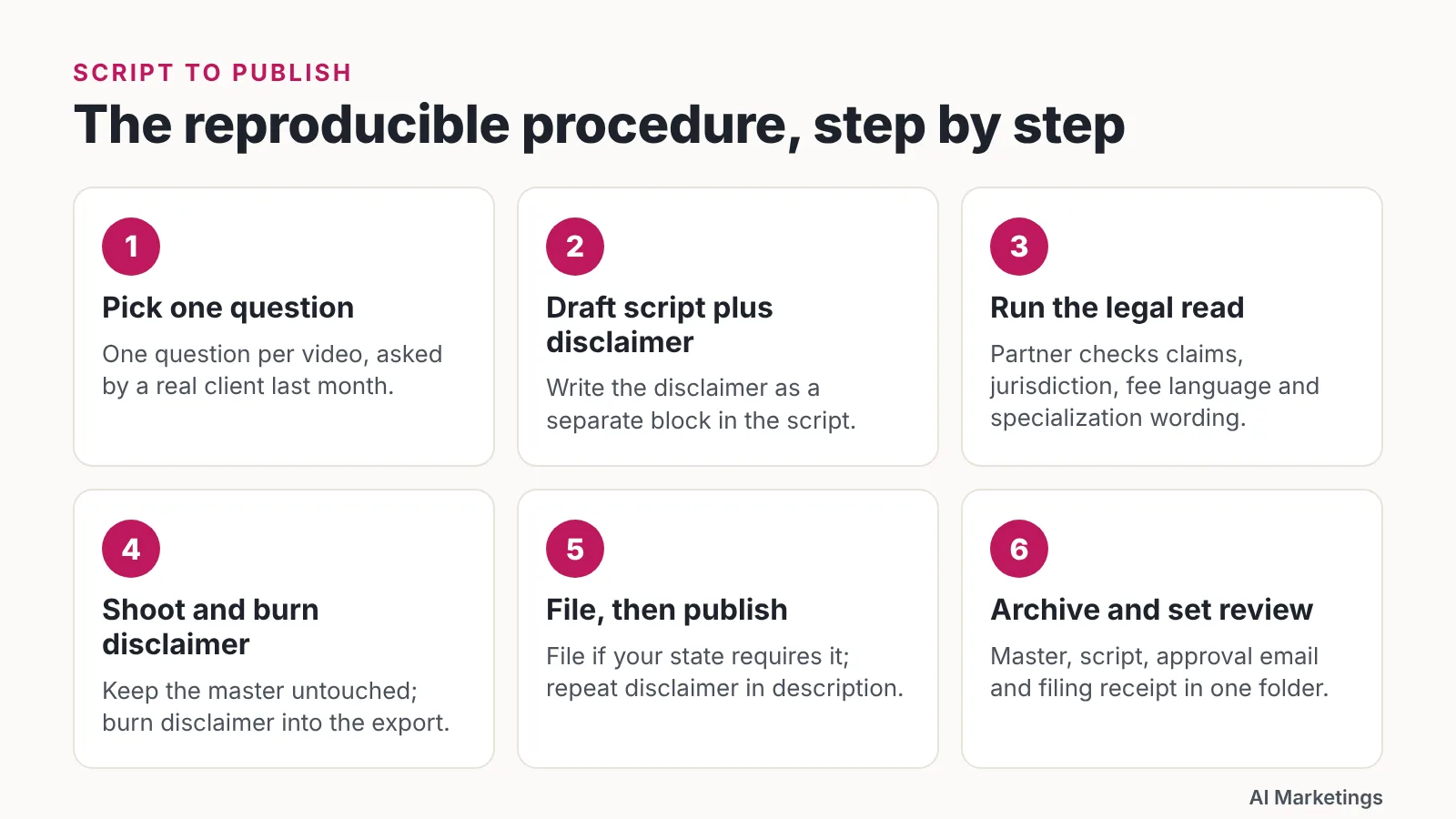
The reproducible nine-step procedure from script to publish
- Pick one question a real client asked last month. One question per video.
- Draft the script at conversational length, with the disclaimer written as a separate block.
- Run the legal read: a partner checks claims, jurisdiction, fee language, and specialization wording.
- Shoot or generate the video, keeping the master file untouched.
- Burn the on-screen disclaimer into the export, not just the caption field.
- File with the bar if your state requires it, according to your state’s rule and deadline.
- Publish, with the same disclaimer repeated in the description.
- Archive the master, the script, the approval email, and the filing receipt in one folder.
- Set a review date to check for outdated statements of law.
Pre-approval is an option worth pricing. Texas lawyers who want a video pre-approved must submit it to the Advertising Review Committee at least 30 days before first dissemination, and the State Bar of Texas charges a $100 application fee for advertising review.
Step four is where production tools matter. For explainers and FAQ answers with no attorney on camera, AI Studios from DeepBrain AI generates avatar-narrated video from a script, a topic prompt, a web URL, an uploaded document, or a product page, and its Docs to Video feature accepts .ppt, .pptx, .pdf, .doc, .docx, .xlsx and .txt files up to 20 MB. The platform lists ISO 27001 certification, SOC 2 Type II compliance and GDPR compliance, and is a member of the Content Authenticity Initiative. One rule to script in advance: if an AI avatar — or any non-lawyer voice, image, or actor — portrays a lawyer or a client, Florida Rule 4-7.13(b)(5) and Comment 3 to Texas Rule 7.01 require a disclaimer saying so.
The limitation is straightforward: an AI avatar cannot be your attorney intro. Prospects hiring someone to handle a parent’s estate want the actual face of the person taking the call, so shoot those on a real camera.
Testimonials, past results and dramatizations: what the rules allow on camera
Testimonial video is permitted in some states, under conditions, and the conditions start early. Florida Rule 4-7.13(b)(8) permits client testimonial videos only if conditions are met, beginning with the speaker being qualified to evaluate the lawyer, according to The Florida Bar News advertising update. A neighbor who once watched you argue a motion does not qualify.
Past results are regulated separately and the guidance shifts. The Texas Supreme Court changed the guidance on advertising past successes and results by amending Comment 10 to Rule 7.01 of the Texas Disciplinary Rules of Professional Conduct, per the State Bar of Texas advertising review page. Check the current comment text before any verdict figure appears in a frame.
Dramatizations need labeling, not just good taste. Florida’s deceptive-advertising rule targets dramatized scenes that viewers could mistake for real events, which is why reenactment footage in law firm video needs an on-screen label, according to the Florida Supreme Court’s amendments to Subchapter 4-7. Hired actors, staged courtroom shots, and stock footage of a car crash all fall here — and where an actor or other non-lawyer voice or image portrays a lawyer or client, Florida Rule 4-7.13(b)(5) and Comment 3 to Texas Rule 7.01 require a disclaimer disclosing the portrayal.
A practical stance: if the scene shows something that did not happen to a real client of yours, label it clearly and conspicuously so a reasonable viewer knows it is a dramatization.
Where the video lives: firm website, paid social, and search placements
Placement changes what the video triggers. The same 90-second explainer can be exempt content in one context and a filed advertisement in another, depending on your state’s definition of a communication directed to prospective clients.
- Firm website, About or Practice Area page. Lowest friction in most states, since visitors sought you out. Still needs accurate credential and fee language.
- YouTube channel, organic. Treated by many bars as a public advertisement. Keep the disclaimer burned in, because descriptions get truncated.
- Paid social (Meta, LinkedIn, TikTok). Targeted, paid, and promotional, which is the combination most likely to require filing and retention in the states that require filing at all.
- Search and video ads (Google, YouTube pre-roll). Same exposure as paid social, plus keyword-level claims that can imply specialization you have not earned.
- Email to existing clients. Often a different rule category entirely, since these are not prospective clients.
Run the placement decision past your compliance sign-off at script stage, not at launch. A video approved as a website explainer may need a new filing when the same cut becomes a pre-roll ad with a call-to-action card.
What to measure after publishing, and when an edit means refiling
View count tells you almost nothing about a law firm video. Track the metrics that map to intake instead: consultation requests attributed to the page hosting the video, watch time past the halfway mark, and whether callers reference something they heard on camera. Ask that last question at intake and log the answer.
Measure per video type, not in aggregate. Explainers usually drive top-of-funnel traffic; process walkthroughs shorten consults because clients arrive knowing the steps.
The refiling trigger is not the same in both filing states. Texas requires a new filing when the substance of the advertisement changes — new footage, a new claim, a changed fee statement, a removed disclaimer, or a new target audience — so trimming three seconds of silence is housekeeping there, not a new ad. The Florida Bar is stricter: it treats any change of any kind, including a change of color scheme, as a new advertisement requiring a new filing and a new filing fee.
Rebuild the filing timeline whenever that happens. Rule 7.04 of the Texas Disciplinary Rules of Professional Conduct sets the deadline at no later than ten days after the date an advertisement is disseminated, according to the State Bar of Texas, so a re-cut that counts as a new ad restarts that clock. Keep the old version archived, because the file you can produce on request is the one that protects you.
Frequently asked questions
Do I have to file my law firm video with the bar before publishing it?
It depends on your state, and only a minority of states — Texas and Florida among them — require filing at all. In Texas, a lawyer must file an advertisement with the State Bar’s Advertising Review Committee no later than ten days after the date it is disseminated, per Rule 7.04, while Texas lawyers wanting pre-approval submit at least 30 days before first dissemination.
What does advertising review cost?
The State Bar of Texas charges a $100 application fee for advertising review. In Florida, since July 1, 2026 the advertisement filing fee has been $250 per timely filed advertisement, with timely meaning filed 20 or more days before intended use, and $750 for a late-filed advertisement, according to The Florida Bar.
Can I publish client testimonial videos?
Sometimes, under conditions. Florida Rule 4-7.13(b)(8) permits client testimonial videos only if conditions are met, starting with the speaker being qualified to evaluate the lawyer, per The Florida Bar News. Check your own state rule before filming anyone, and get a signed release regardless.
What file format should I submit for bar review?
When a Florida firm submits a video ad for review, MP4 is the preferred delivery format, with MP3 for audio, according to The Florida Bar’s filing requirements. If the filing is incomplete or raises questions, the bar sends its request for more information within 15 days of receipt.
Can I use actors or reenactments in a law firm video?
Only with a clear on-screen label. Florida’s deceptive-advertising rule targets dramatized scenes that viewers could mistake for real events, per the Florida Supreme Court’s amendments to Subchapter 4-7, so staged courtroom shots and crash footage need a clear and conspicuous dramatization notice. If an actor or other non-lawyer voice or image portrays a lawyer or client, Florida Rule 4-7.13(b)(5) and Comment 3 to Texas Rule 7.01 require a disclaimer disclosing that too.
Sources
- Texas Disciplinary Rules of Professional Conduct, Rule 7.04 — State Bar of Texas
- Advertising Review — State Bar of Texas
- Advertising Regulation and Information — The Florida Bar
- Lawyer Advertising Filing Requirements — The Florida Bar
- Advertising Update — The Florida Bar News
- In re: Amendments to Rules Regulating The Florida Bar – Subchapter 4-7 (Fla. Sup. Ct., via FindLaw)
Written with AI assistance and fact-checked against the sources cited above before the AI Marketings Editorial Team published it.
This article is general information, not legal advice; check your state bar’s current rules.