The main types are short-form social, explainer, demo, testimonial, case study, live, webinar, how-to and brand story — plus ad creative as a tenth — matched to funnel stage: reach up top, proof in the middle, support after purchase.

What Is Video Marketing? A Plain-English Definition
> Video marketing is the use of video to attract, convince and keep customers — on your site, in email, on social platforms and in paid placements, measured against marketing goals rather than view counts.
The word "marketing" carries the weight there. A polished brand film that nobody is responsible for distributing is a video, not video marketing.
According to Wix’s video marketing statistics report, 91% of businesses use video marketing in 2026, up from 89% the previous year. That makes video a baseline channel rather than an experiment you pitch internally.
What counts is broader than most people assume. A screen recording a sales rep sends to a stalled prospect, a 40-second vertical clip on a product update, a recorded webinar gated behind a form, a help-center walkthrough that cuts support tickets — all of it is video marketing.
The practical consequence: you are not choosing whether to "do video." You are choosing which types to make, in what order, for which audience moment.
Treat every video as the answer to one question, for one person, at one stage. Videos that try to serve three audiences at once tend to serve none.
The Main Types of Marketing Video (and What Each One Is For)
Nine working types cover almost everything a small team needs, plus paid ad creative as a tenth. The table below is the working list: each type has a job, and the job determines length, tone and where it lives.
| Type | What it is | Best used for |
|---|---|---|
| Short-form social video | A hook-first vertical clip built for sound-off scrolling | Reach, awareness, testing messages fast |
| Explainer | A tight piece showing the problem and how your product solves it | Homepage, paid landing pages, cold audiences |
| Product demo / walkthrough | A screen or hands-on tour of the actual thing | Mid-funnel evaluation, sales follow-up |
| Customer testimonial | A buyer telling the story in their own words | Proof at the decision stage |
| Case study video | Testimonial plus the before-and-after specifics | Enterprise deals, long sales cycles |
| Live stream | Unscripted real-time Q&A, launch or AMA | Objection handling, community, launches |
| Webinar / long-form educational | Deep teaching, usually behind a registration form | Lead capture for considered purchases |
| How-to and onboarding video | Step-by-step guidance for existing customers | Retention, activation, ticket deflection |
| Brand story / culture | People, origin, values, how the work gets done | Recruiting, trust, press and partnerships |
| Ad creative | Any of the above cut to a paid placement’s rules | Bought attention with a measurable cost per result |
Ad creative sits slightly apart because it is not a tenth kind of story. It is any of the nine types recut to a placement’s rules and paid into a feed.
Wix’s video marketing statistics report found that social media videos are the most commonly produced type in 2026, created by 69% of video marketers, ahead of explainer videos at 68% and testimonial videos at 57%.
That ordering is a clue, not an instruction. Social video is produced most because it is cheapest to attempt and fastest to publish, which is a different thing from being most valuable for your business.
If you sell an inexpensive repeat-purchase product, short-form social and how-to content will carry most of the load. If you sell a high-value contract with a long approval chain, testimonials and case study videos do the convincing, and social clips only start the conversation.
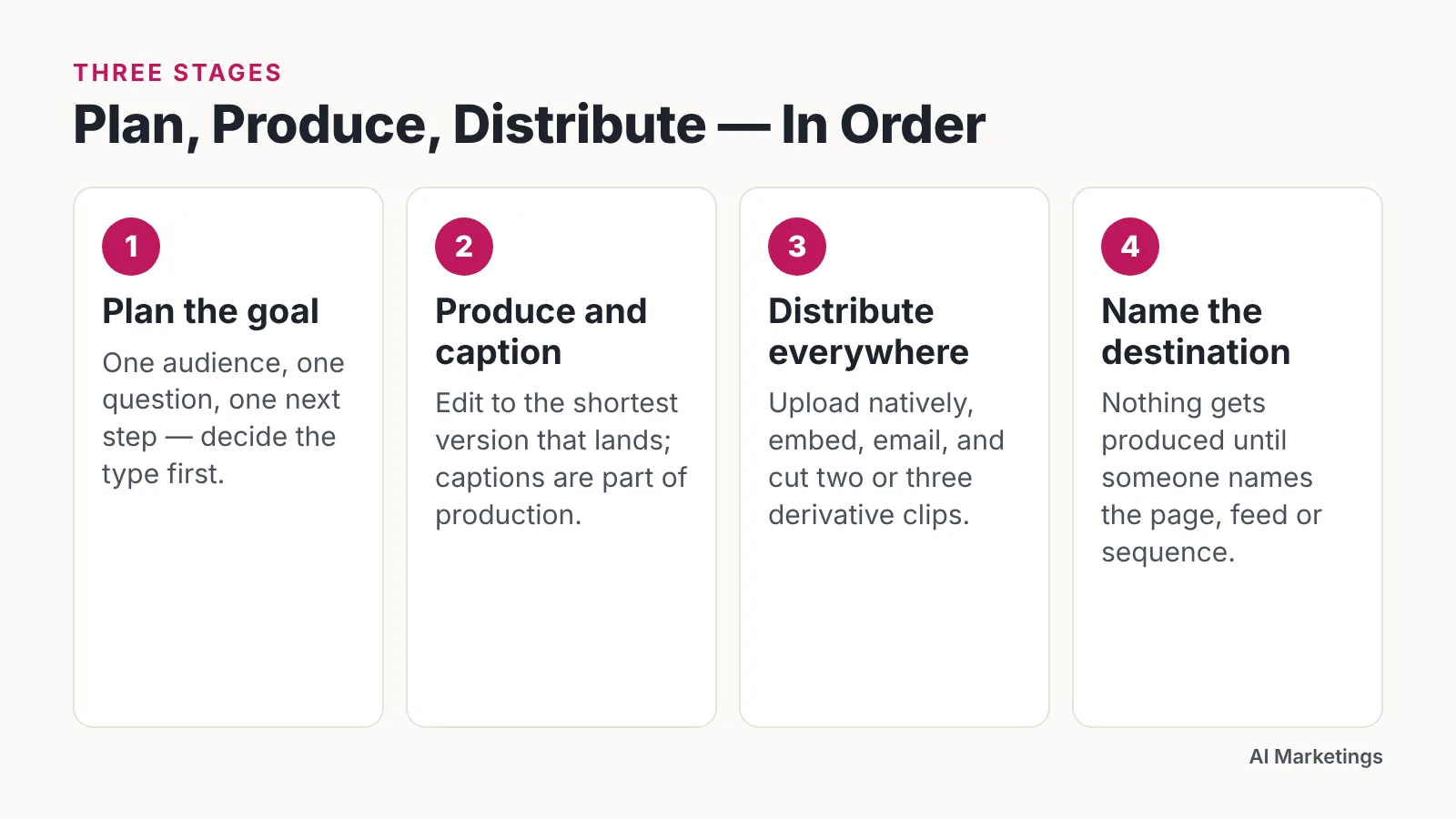
How Video Marketing Works in Three Stages: Plan, Produce, Distribute
- Plan. Write the goal before the script: one audience, one question, one next step. Decide the type first — a testimonial and an explainer need different people, locations and release paperwork.
- Produce. Shoot, record or generate the footage, then edit to the shortest version that still lands. Captions are part of production, not an afterthought.
- Distribute. Upload natively to each platform, embed on the relevant page, put it in the email sequence it belongs to, and cut two or three derivative clips from the master.
HubSpot’s video marketing statistics roundup reports that 55% of marketers make videos in-house, 14% outsource to vendors and 31% use a mix of both. In-house is the default now, which changes what "good enough" means.
Most teams underweight the third stage. A single webinar recording can become a gated replay, three short social cuts, one email-embedded clip and a help-center chapter — same production cost, four more placements.
Build a simple rule: nothing gets produced until someone names the page, feed or sequence it will live in. That one habit kills the orphan-video problem.
Video Marketing vs. Video Advertising: What’s Actually Different
Video advertising is a subset of video marketing — the part where you pay a platform to put your video in front of people who did not seek it out.
| Video marketing | Video advertising | |
|---|---|---|
| Distribution | Owned, organic, email, embeds, search | Paid placements you bid for |
| Attention | Earned or requested | Bought, often interrupting |
| Format freedom | You set the length | The platform sets hard limits |
| Time to results | Compounds over months | Measurable within days |
| Main metric | Pipeline, retention, assisted conversions | Cost per result, ROAS |
The practical difference shows up in the first three seconds. An organic viewer who tapped your profile has already opted in; a pre-roll viewer is one click from skipping and has to be given a reason to stay.
That is why repurposing an explainer directly as an ad usually underperforms. The explainer opens by setting up a problem, and an ad has to open by interrupting one.
When to Use Each Type: Matching Video to Funnel Stage, Platform and Budget
| Stage | Use these types | Where they live |
|---|---|---|
| Awareness | Short-form social, brand story, ad creative | Feeds, Shorts, Reels, paid in-stream |
| Consideration | Explainer, product demo, webinar, live stream | Landing pages, YouTube, registration pages |
| Decision | Testimonial, case study video, product demo | Sales emails, pricing page, proposals |
| Retention | How-to and onboarding video, product update | Help center, in-app, lifecycle email |
HubSpot’s video marketing statistics roundup found that short-form video is the single format most often named the highest-ROI type, cited by 21% of marketers, with live-streaming ranking third at 15.53%.
Budget sets the realistic ceiling. Wix’s video marketing statistics report shows 46% of marketing teams allocate a third or less of their marketing budget to video in 2026, and 17% do not track video spend at all.
With a modest budget, pick two types and run them weekly rather than attempting all nine. A steady stream of demos and testimonials beats one brand film that takes a quarter to approve.
Platform matters as much as stage. Live streams reward a channel where you already have an audience to show up; a testimonial works almost anywhere, including a pricing page with no audience at all.
Format Rules to Plan Around: Lengths, Aspect Ratios and Ad Limits
Google Ads Help states that the standard non-skippable in-stream ad format runs between 7 and 15 seconds, which sets a hard ceiling on what a non-skippable ad can say.
Plan your crops before you shoot, not in the edit:
- Vertical (9:16) as the master for feed and story placements, with headroom so captions do not cover faces.
- Widescreen (16:9) for YouTube, site embeds and webinar replays.
- Square (1:1) as a fallback when one asset has to run in several feeds.
Choose the master ratio by where the video will be seen most often, then crop down from it rather than stretching a small frame up.
On length, the Google Ads limit above is the only published rule in this section. The numbers that follow are editorial rules of thumb drawn from practice, not sourced standards: keep short-form social under 60 seconds, explainers around 90 seconds, demos under three minutes, testimonials under two, and let webinars run as long as the teaching requires.
Shoot wide enough to recrop. A single interview framed with space on both sides gives you a widescreen case study and three vertical pull-quote clips from one sitting.
Burn in captions or upload caption files everywhere. Sound-off viewing is the norm in feeds, and uncaptioned video loses the first sentence that was supposed to hook people.

Where AI Tools Fit: Making More Video Types With a Small Team
Wix’s video marketing statistics report found that 63% of video marketers use AI tools to create or edit marketing videos in 2026, compared with 51% in 2025.
The fit is uneven across types. AI handles repeatable, script-driven formats well — product updates, onboarding steps, localized versions of an explainer, internal training — and handles emotional, proof-carrying formats poorly.
One option in that script-driven category is AI Studios, DeepBrain AI’s platform for AI avatar and text-to-video content, which combines avatar video creation, text-to-video, dubbing and text-to-speech in one workspace. It can build a video from a script, a topic prompt, a web URL, an uploaded document or a product page, and it offers text-to-speech in 150+ languages and accents on paid plans and 30+ languages on the Free plan. It is sold in Free, Personal, Team and Enterprise plans, so a single marketer and a full content team can start at different tiers.
The limitation is worth stating plainly: an avatar reading a script cannot replace a customer testimonial, and buyers can tell. For proof-stage video, record the actual customer, even on a phone.
Same logic for live streams and hands-on demos. The value there comes from being unedited and real, which is exactly what generated video removes.
A workable division of labor: let AI carry the types that scale with your catalog and your languages, and spend your camera time on the types that carry proof.
Frequently asked questions
Which types of marketing video are most common?
According to Wix’s video marketing statistics report, social media videos lead at 69% of video marketers in 2026, followed by explainer videos at 68% and testimonial videos at 57%. Common does not mean correct for your business — a long sales cycle usually needs testimonials and case study videos more than trend clips.
Which type of video delivers the best return?
HubSpot’s video marketing statistics roundup found short-form video is the format most often named highest-ROI, cited by 21% of marketers, with live-streaming third at 15.53%. Your returns depend on price point and cycle length, so track assisted conversions by video type before committing budget.
How long should each type of video be?
Google Ads Help specifies that standard non-skippable in-stream ads run between 7 and 15 seconds. For organic formats there is no published rule, so treat these as editorial defaults: under 60 seconds for social clips, around 90 seconds for explainers, under three minutes for demos, and as long as the teaching requires for webinars.
Do I need an agency to produce these video types?
HubSpot’s video marketing statistics roundup reports that 55% of marketers produce video in-house, 14% outsource to vendors and 31% use both. A workable split keeps demos, how-tos and social clips in-house and reserves outside help for brand films and multi-location shoots.
Can AI tools make every type of marketing video?
Wix’s video marketing statistics report found 63% of video marketers use AI to create or edit videos in 2026, up from 51% in 2025. AI suits script-driven formats like product updates and onboarding, but testimonials, live streams and hands-on demos still need real people on camera.
Sources
Written with AI assistance and fact-checked against the sources cited above before the AI Marketings Editorial Team published it.