An AI marketing consultant audits how your marketing gets made, selects AI tools for those steps, builds prompts and automations, then trains your team. Hiring one pays off when output is capped by process, not headcount.
What Is an AI Marketing Consultant?
Definition: An AI marketing consultant is an outside specialist who audits how your marketing actually gets made, selects AI tools that fit those steps, builds the prompts and automations, and trains your team to run them.
The job title is new. The work underneath it is old — process design, tool selection, and staff enablement, aimed at campaign production instead of a factory floor.
According to McKinsey’s global AI survey, published in its State of AI report dated March 2025, 78 percent of respondents said their organizations used AI in at least one business function, up from 72 percent in early 2024. Access to tools stopped being the bottleneck. Turning scattered, personal tool use into repeatable team output is where the money and the frustration sit.
How the work runs, in three steps:
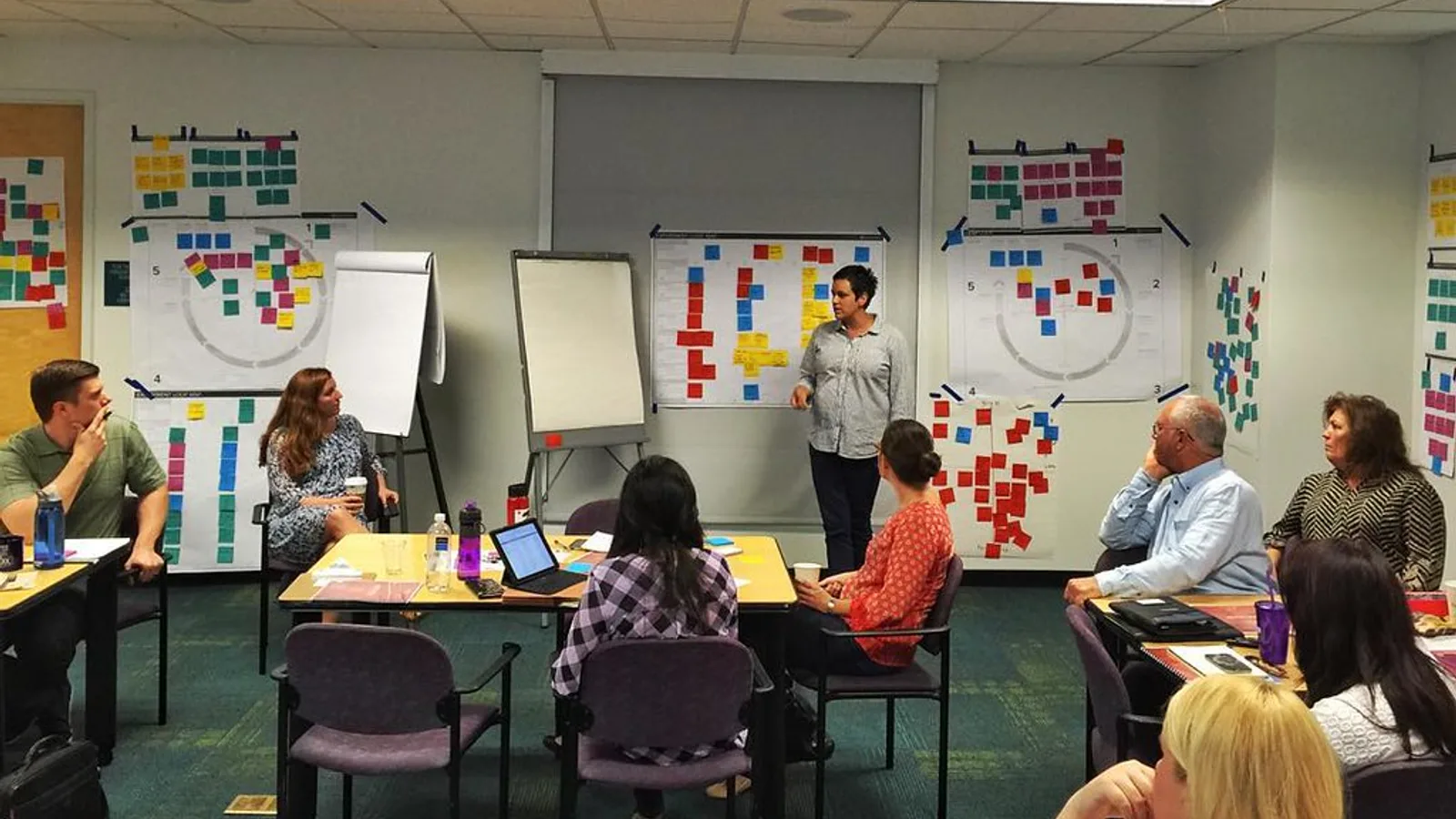
- Map. The consultant traces one campaign from brief to published — who writes, who approves, where it stalls for three days.
- Rebuild. Specific steps are replaced with AI-assisted versions: a drafting prompt tied to your voice, a repurposing chain, an automated reporting pull.
- Hand off. Your team receives the prompts, the checklists, and the training needed to run it after the invoice is paid.
Not the same as a marketing automation consultant
A marketing automation consultant configures plumbing: email sends, CRM fields, lead scoring rules, lifecycle triggers. An AI marketing consultant changes what flows through that plumbing — how copy, creative variants, audience segments, and reports get produced in the first place. Plenty of engagements touch both, but the opening question is different, and so is the person you should call.
What an AI Marketing Consultant Actually Does (Day-to-Day Deliverables)
Judge the role by its artifacts, not its vocabulary. Everything below should be something a marketing manager can open and use on a Monday morning.
- Workflow map: your current content, email, and paid process written out step by step, with time cost per step.
- Tool stack recommendation: which tools to keep, which to cancel, and which single addition fixes the biggest bottleneck.
- Prompt library: reusable prompts for your offers, your audience, your objections — stored where the team already works.
- Brand voice file: the source document every prompt references so three people produce one recognizable tone.
- Review and governance checklist: who verifies claims, what never ships without a human read, how customer data is handled.
- Measurement plan: baseline output and hours before the change, the same two numbers after.
- Training sessions: recorded, so the person you hire in March can still learn the system in September.
McKinsey reported that only twenty-seven percent of organizations using gen AI have employees review all AI-created content before it is used, which is exactly why a human review step belongs in any scope you sign. A consultant who skips governance is selling speed and leaving you the liability.
What the role usually is not: an ongoing copywriter, a media buyer, or a person who runs your campaigns forever. If the proposal reads like outsourced production, you are buying an agency under a different name.
How an Engagement Works: Audit, Pilot, Scale
McKinsey found that only twenty-one percent of organizations using gen AI have fundamentally redesigned any of their workflows around it, and that structural redesign is the specific thing a consultant is hired to deliver. The sequence below is how that redesign usually gets staged.
Phase 1 — Audit
The consultant interviews the people who actually produce the work, not just the owner. They time the steps, collect the tools already in use, and identify the one or two workflows where AI changes the economics. Expect a short written findings document and a prioritized shortlist rather than a sixty-slide deck.
Phase 2 — Pilot
One workflow gets rebuilt. Ask for a scope narrow enough to finish in weeks rather than quarters, and measurable enough to argue about — for example, cutting blog production from five handoffs to two, or generating ad variant sets your buyer actually ships.
Set the success criteria before the pilot starts. Hours saved per week, drafts approved on first pass, or cost per published asset all work. Vague goals like "more efficiency" guarantee a vague invoice conversation later.
Phase 3 — Scale
Whatever survived the pilot gets documented, templated, and taught to the rest of the team. This phase is mostly enablement: training sessions, a prompt library handover, and a review cadence. Push for a defined end date so the engagement does not quietly become a permanent retainer.

AI Marketing Consultant vs. Marketing Agency vs. In-House Hire
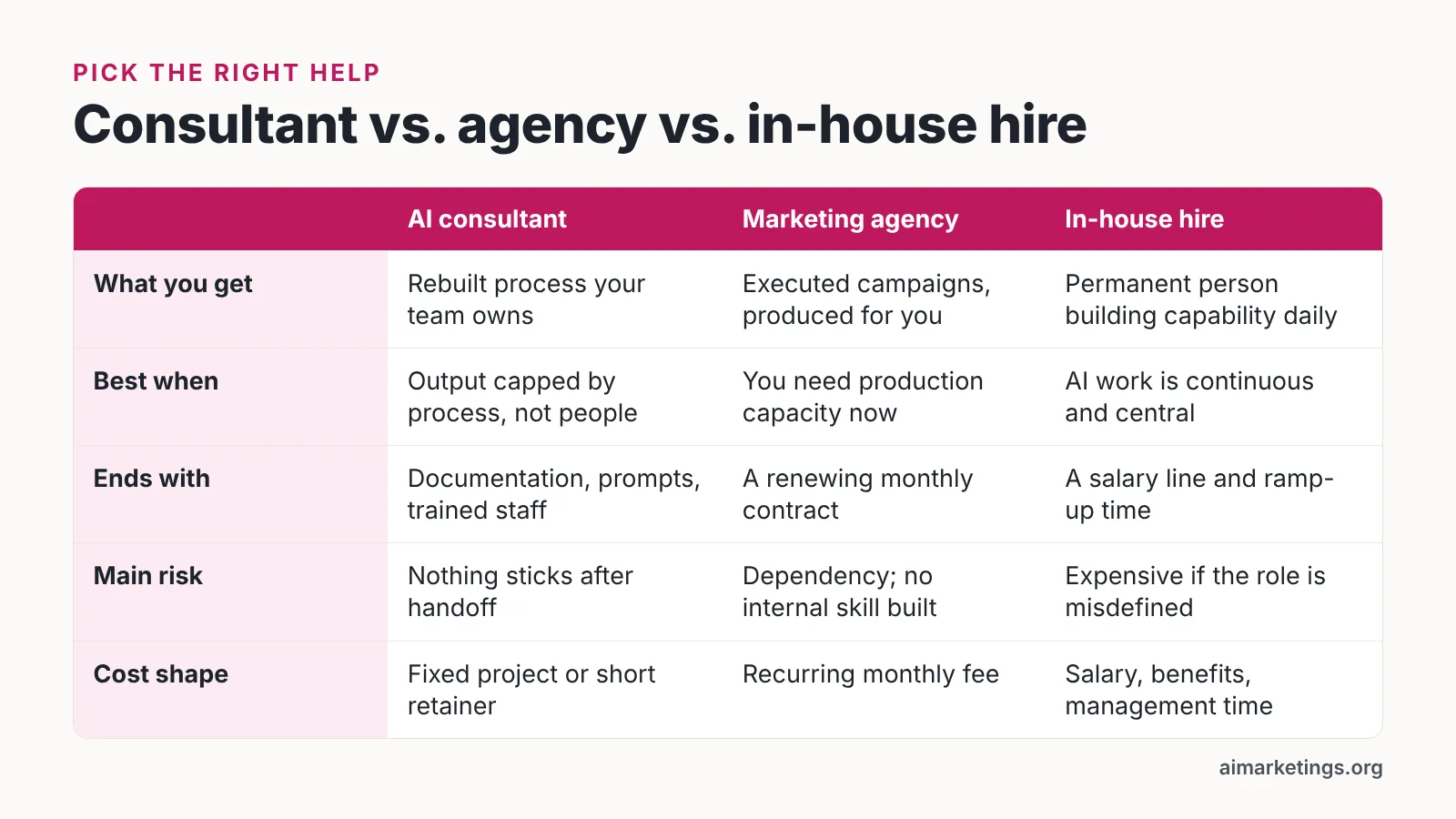
| AI marketing consultant | Marketing agency | In-house AI-fluent hire | |
|---|---|---|---|
| What you get | A rebuilt process your team owns | Executed campaigns, produced for you | A permanent person building capability daily |
| Best when | Output is capped by process, not people | You need production capacity now | AI work is continuous and central |
| Ends with | Documentation, prompts, trained staff | A renewing monthly contract | A salary line and ramp-up time |
| Main risk | Nothing sticks after handoff | Dependency; no internal skill built | Expensive if the role is misdefined |
| Cost shape | Fixed project or short retainer | Recurring monthly fee | Salary, benefits, management time |
Marketing Dive, citing Gartner research, reported that 27% of CMOs have no or limited generative AI adoption in their teams, while 47% of adopters see a large benefit for tasks such as campaign evaluation and reporting. Both numbers argue for a consultant in the same way: the gap is organizational, not technological.
Pick the agency if you need hands producing work this quarter. Pick the hire if AI-assisted production will be a permanent, daily function. Pick the consultant when your team is capable but the process around them is stuck.
Where Small Teams Use Them: Practical Use Cases
According to McKinsey, 55% of technology respondents and 49% of professional services respondents reported regular gen AI use in marketing and sales, making it one of the most AI-saturated functions in business. Small teams usually bring a consultant in for one of these jobs.
- Content throughput: a two-person team publishing once a month wants four pieces, with the same voice and no new headcount.
- Local service businesses: turning one job site photo set into listing updates, email, and social posts without hiring an agency.
- Ecommerce product copy: generating and reviewing hundreds of descriptions against one brand style file, with a human spot-check rule.
- Paid media variants: producing structured ad copy sets for testing, so the media buyer tests messages instead of writing them.
- Reporting: replacing the Friday afternoon of copy-pasting metrics with a pulled, summarized draft a human edits.
- Sales enablement: personalizing outreach sequences by segment while keeping claims accurate and approved.
Notice the pattern. Each case has a repeatable step, an existing volume problem, and a clear owner who will keep running the system after handoff.
When Hiring an AI Marketing Consultant Is Worth It — and When It Isn’t
Gartner found that just 5% of marketing leaders who treat generative AI only as a tool report significant gains on business outcomes, which is the strongest available argument against buying software and calling it a strategy. Tools alone rarely move the business line.
Worth it when:
- You have a working offer and steady demand, but production cannot keep up.
- Three people use three different tools, and the output sounds like three companies.
- You tried AI drafts, got bland copy, and nobody owns fixing the prompts.
- A compliance or accuracy concern is blocking adoption and you need a review process designed.
Not worth it when:
- Your positioning is unclear. AI will scale the confusion faster.
- You have no traffic source and no list; the bottleneck is demand, not drafting.
- Nobody on the team has time to be trained or to own the new process.
- You want someone to run campaigns indefinitely — that is an agency or a hire.
Gartner also reported that sixty-five percent of CMOs surveyed believe AI advances will dramatically transform their role within the next two years, so the question for most teams is timing and sequencing rather than whether to engage at all.
What It Costs and How to Scope the Engagement
Pricing comes in four shapes, and the shape tells you more than the number does.
- Hourly or day rate: fine for advisory sessions and tool questions, risky for anything open-ended.
- Fixed-fee audit: a defined deliverable with a defined end date. The safest first purchase.
- Project fee per workflow: audit plus pilot plus handover, priced as one scope.
- Short retainer: monthly support during scale-up, with an agreed finish date rather than auto-renewal.
Public benchmarks for these rates are thin, so compare proposals with relative anchors instead of absolute ones. As a rule of thumb, a fixed-fee audit should sit below one month of an equivalent agency retainer, because it buys a diagnosis rather than production. A project fee covering audit, pilot, and handover should cost more than the audit alone but still less than the equivalent hire would cost you over the same period. A quote that breaks those relationships is worth questioning before you sign.
Scope the first engagement around one workflow. A narrow pilot you can evaluate beats a broad transformation you cannot measure, and it caps your downside if the fit is wrong.
Put five things in the statement of work: the workflow being rebuilt, the artifacts you will receive, the success metric and its baseline, the training included, and who owns the prompts and accounts afterward. That last item matters more than people expect. If the consultant’s personal account holds your prompt library, you did not buy capability — you rented it.
Ask for a baseline measurement before any build starts. Without a before number, every after number is a story.
How to Choose One: Proof to Ask For and Red Flags to Avoid
Salesforce’s State of Marketing research found that full AI integration is still unfinished for 61% of marketers even though basic adoption is widespread, so experience with messy, half-finished stacks matters more than polished theory.
Proof to ask for:
- A redacted deliverable from a past engagement — an actual prompt library or workflow map, not a case study summary.
- A client who will talk about what still runs six months after handoff.
- A clear answer on how they handle customer data and where it is processed.
- Their review process for factual claims in AI-generated copy.
- Named tools they recommend against, and the reasoning behind it.
Red flags:
- Guaranteed percentage gains with no access to your baseline data.
- A proposal that ends in a permanent retainer with no handover milestone.
- Reselling one platform as the answer to every problem, with a referral fee attached.
- No mention of human review, approvals, or brand safety anywhere in the scope.
- Heavy promises about fully autonomous agents running your marketing.
On that last point, Salesforce reported that only thirteen percent of marketers currently use agentic AI, while 82% of marketers who use or plan to use agents expect major or moderate improvements to marketing ROI. Enthusiasm is ahead of deployment. A consultant worth hiring will tell you that plainly instead of selling you the gap.
Frequently asked questions
Do I still need an AI marketing consultant if my team already uses ChatGPT?
Individual tool use and a team system are different things. McKinsey reported that only twenty-one percent of organizations using gen AI have fundamentally redesigned any workflow around it, which is the gap a consultant closes with shared prompts, review rules, and training.
How long does a typical AI marketing consulting engagement last?
Most follow three phases — audit, pilot on one workflow, then scale and handover. Ask for a scope that can finish in weeks rather than quarters, and insist on a defined end date in the contract so a project does not drift into an open-ended retainer.
Will an AI marketing consultant replace my agency or my copywriter?
Usually not. A consultant rebuilds how work gets produced and then leaves; an agency produces the work every month. Many teams keep their writer, who moves from first drafts to editing, fact-checking, and higher-value strategic pieces.
What should I measure to know the engagement worked?
Set a baseline before the build: hours per asset, assets published per month, drafts approved on first pass, and cost per published piece. Compare the same four numbers thirty and ninety days after handover, not just during the pilot.
Is AI consulting worth it for a small business with no marketing team?
Sometimes, but demand problems come first. Gartner found that just 5% of marketing leaders who treat generative AI only as a tool report significant gains on business outcomes — in other words, adding AI on top of existing activity rarely moves business results by itself. A consultant can only speed up a process that already produces sales, so if there is no clear positioning and no traffic source, fix those first.
Sources
- The state of AI: How organizations are rewiring to capture value — McKinsey
- Gen AI’s broad reach — McKinsey
- The state of AI: How organizations are rewiring to capture value (PDF report, March 2025) — McKinsey
- Gartner Survey Finds 65% of CMOs Say Advances in AI Will Dramatically Change Their Role in the Next Two Years
- State of Marketing Report — Salesforce
- 27% of CMOs remain reluctant to adopt generative AI: Gartner — Marketing Dive
Written with AI assistance and fact-checked against the sources cited above before the AI Marketings Editorial Team published it.