An AI-powered marketing cloud is one platform that unifies customer data, lets models choose audiences, content and timing, and runs campaigns across channels — a classic suite only connects tools and waits for you to decide.

What is an AI-powered marketing cloud?
Most teams already pay for a dozen tools that barely talk to each other. This category exists because that sprawl got expensive and slow.
Definition: A platform that holds unified customer profiles, applies models to select audiences, content and send timing, then executes campaigns across email, ads, web and mobile under one set of governance rules.
The word cloud describes breadth, not hosting. You get profile storage, segmentation, journey orchestration, content generation and reporting from one vendor, on one data model. A point tool does one of those jobs; a cloud carries the whole sequence from raw event to delivered message.
AI appears in three concrete places: who gets targeted, what the asset says, and when it sends. Salesforce’s State of Marketing research reports that 63% of marketers are currently using generative AI. That adoption wave is why nearly every suite vendor rewrote its product page in the last two years.
Treat the label skeptically. Some products are genuinely model-driven; others bolted a copy assistant onto a 2015 email engine. The test is whether the model can read the full customer profile or only the handful of fields attached to one campaign.
The four building blocks: unified customer data, AI models, channel execution, and governance
Every credible platform in this category assembles the same four parts. Judge vendors on all four, because a gap in one quietly disables the others.
- Unified customer data. Identity resolution stitches a web cookie, an email address, a loyalty ID and an app install into one profile. Without it, your "AI" is scoring strangers.
- AI models. Two families matter: predictive models that score likelihood to buy, churn or open, and generative models that draft subject lines, body copy and image variants.
- Channel execution. Email, SMS, push, paid audience sync, web personalization and increasingly agent-run workflows that act without a human clicking send.
- Governance. Consent capture, suppression rules, brand guardrails on generated copy, approval steps and an audit trail of what the model decided and why.
Speed limits sit underneath all of this, and vendors publish them. Adobe documents that edge segmentation in Adobe Experience Platform supports a combined peak of 1,500 inbound events per second across production and development sandboxes. Numbers like that decide whether a cart-abandon message fires in seconds or in an hour.
Governance is the block buyers skip during demos and regret during audits. Ask to see the consent model and the generated-content approval queue before you look at a single dashboard.
How it works in three stages: unify the data, let AI decide, activate across channels
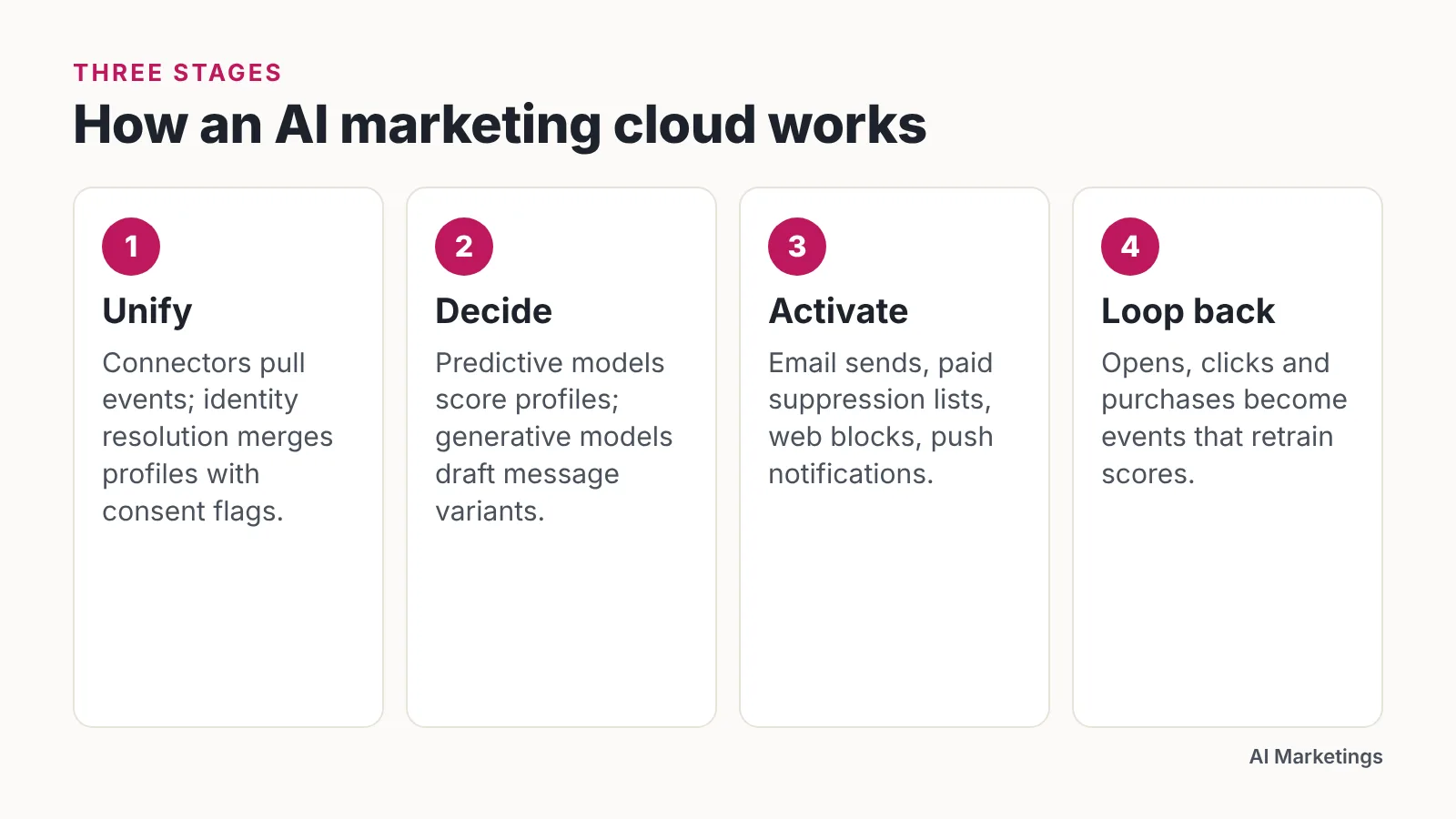
The mechanics are easier than the marketing copy suggests. Three stages, in this order.
- Unify. Connectors pull events from your website, store POS, CRM, support desk and ad accounts. Identity resolution merges them into one profile per person, with consent flags attached.
- Decide. Predictive models score each profile — likely to repurchase, likely to churn, likely to respond to a discount. Generative models then draft the message variants that match each segment.
- Activate. The platform pushes the decision to the channel: an email send, a suppression list for paid social, a changed hero block on your pricing page, a push notification.
Streaming capacity is what separates "real time" from "nightly batch." Adobe Experience Platform customers can buy additional streaming segmentation capacity of up to 13,500 records per second beyond the default entitlement, according to Adobe’s license usage documentation. Ask any vendor what their default entitlement covers and what an upgrade costs.
Results loop back into stage one. Opens, clicks, purchases and unsubscribes become new events, which retrain scores and change the next decision. A platform that cannot close that loop is a send tool with a chatbot attached.
AI-powered marketing cloud vs. classic marketing suite: what actually changed
A classic marketing suite — the 2012-era model — gave you connected modules and a rules builder. You wrote the if/then logic. The system executed it faithfully and learned nothing.
| Classic marketing suite | AI-powered marketing cloud | |
|---|---|---|
| Customer data | Per-module lists, synced on schedule | Shared profile, updated from streaming events |
| Audience building | Manual rules you write | Model scores plus rules you override |
| Content | Human-written templates | Generated variants, human approval |
| Send timing | Fixed schedule or simple triggers | Per-person timing predicted by a model |
| Pricing | Seats and contact tiers | Seats, org fees and consumption credits |
| Main risk | Unused modules | Unreviewed model output and credit overruns |
The substantive change is who makes the decision. In a classic suite, your rules are the ceiling on sophistication; in an AI cloud, the model proposes and you set the guardrails. That shift moves your job from building segments to auditing them.
The second change is billing. Seat-based software cost the same whether you sent one campaign or one hundred, while consumption pricing means usage shows up on the invoice. Plan for that before you let an agent run unattended.
What it costs: seat licenses, org fees, and consumption-based AI credits
Modern pricing stacks three layers, and vendors rarely show all three on one page. You pay for named users, for the org-level edition, and for AI consumption on top.
Start with the published floor. Salesforce lists Marketing Cloud Growth Edition at $1,500 USD per org per month, billed annually. That figure is the entry point for the small-business tier, not the all-in cost of a running program.
Consumption is the layer that surprises finance. Under Salesforce’s consumption pricing, one Agentforce action consumes 20 Flex Credits, which equals $0.10 per action. Multiply that by every automated reply, enrichment and decision an agent takes in a month, then double it for the pilot period when nobody has tuned anything.
There is often a starter allowance. Salesforce customers on Enterprise Edition or above can obtain 100,000 Flex Credits at no cost through Salesforce Foundations. Use an allowance like that to measure your real consumption rate before you commit to an annual credit block.
Budget headroom is thin across the profession. Gartner’s 2025 CMO Spend Survey found marketing budgets stayed flat at 7.7% of overall company revenue. A new platform almost always has to replace spend rather than add to it, so list what you are switching off before you sign.

Practical uses for marketing managers and small-business owners
Skip the enterprise case studies. These are the uses that pay for themselves at normal company sizes.
- Churn-risk win-backs. The model flags customers whose purchase gap is stretching, and a short sequence goes out before they drift to a competitor.
- Paid-media suppression. Recent buyers sync to your ad platforms as an exclusion audience, so you stop paying to re-acquire people you already have.
- Lead triage. Scores route high-intent form fills to a salesperson within the hour and park the rest in nurture.
- Variant generation. Draft five subject lines and three hero blocks per campaign, then approve the two you’d actually send under your own name.
- Local service reminders. For a dental practice or an HVAC company, service-interval data triggers a booking reminder without anyone maintaining a spreadsheet.
Pick one use case and run it for a full quarter. A single working journey teaches your team more about the platform than six half-built ones, and it gives you a clean number to defend at renewal.
Keep humans on approval for anything that names a price, a policy or a person. Generated copy is fast and occasionally confidently wrong.
How to evaluate a platform before you buy (and when you don’t need one)
Run the demo on your data, not theirs. Ask the vendor to ingest a sample export and show identity resolution on real duplicates — the messy ones with a typo’d email and two phone numbers.
Then work through a short checklist:
- Data in: which of your systems have native connectors, and what does a custom one cost?
- Speed: what is the default streaming entitlement, and what triggers an upgrade charge?
- Consumption: what counts as a billable action, and can you cap spend per month?
- Governance: can you see why the model chose a segment, and can a human reject generated copy before send?
- Exit: can you export unified profiles and journey logic if you leave?
Adoption is the risk nobody writes into the contract. Gartner’s 2025 Marketing Technology Survey found that martech stack utilization has fallen to 49%, which means roughly half of what companies buy sits idle.
You probably don’t need one yet if you run a single channel, your customer list lives in one clean system, and nobody on the team owns data operations. A good email tool plus disciplined segmentation will beat an underused cloud every quarter.
This article is general information about software purchasing, not legal or financial advice; check contract and data-protection terms with your own advisers.
Frequently asked questions
What is the difference between an AI-powered marketing cloud and a CDP?
A customer data platform builds and shares unified profiles; an AI-powered marketing cloud includes that profile layer and adds models, content generation and channel execution. Many clouds embed a CDP, so buying both often duplicates identity resolution you already pay for.
How much does an AI-powered marketing cloud cost for a small business?
Expect three layers: seats, an org-level edition fee and AI consumption. Salesforce lists Marketing Cloud Growth Edition at $1,500 USD per org per month, billed annually, and that figure excludes implementation work and the credits your automations burn each month.
How is AI consumption actually billed?
Per action rather than per seat. Under Salesforce’s consumption pricing, one Agentforce action consumes 20 Flex Credits, which equals $0.10 per action, so an agent handling thousands of replies a month creates a variable line item you should cap during the pilot.
Do I need clean data before I buy one?
Yes, at least directionally. Identity resolution can merge duplicates and typos, but it cannot invent consent records or purchase history you never captured, so audit your sources first and fix the two systems that feed most of your revenue.
How long does it take to see results?
Plan on a quarter for one journey: a few weeks to connect sources and resolve identities, a few more to train scores on real behavior, then a full send cycle to compare against your previous baseline. Teams that launch six journeys at once usually finish none.
Sources
- Marketing Cloud Pricing Editions: Small Business | Salesforce
- Salesforce Introduces New Flexible Agentforce Pricing to Accelerate the Digital Labor Revolution
- Gartner 2025 CMO Spend Survey Reveals Marketing Budgets Have Flatlined at 7.7% of Overall Company Revenue
- Maximize ROI With Marketing Technology (Martech) | Gartner
- Default guardrails for Real-Time Customer Profile data and segmentation | Adobe Experience League
- License usage and capacities | Adobe Experience League
- The Top Marketing Statistics to Know | Salesforce
Written with AI assistance and fact-checked against the sources cited above before the AI Marketings Editorial Team published it.