Generative AI for marketing is software that drafts new assets — copy, images, audio, video — from prompts and your data, speeding work at every funnel stage, while adding risks around accuracy, disclosure law, search spam policies, and brand safety.
What Is Generative AI for Marketing?
Marketing adopted these tools fast because most marketing work is artifacts. Subject lines, ad variants, product descriptions, scripts, landing page sections. A generative model drafts those from instructions rather than from a fixed template.
In McKinsey’s 2024 Global Survey on AI, 65% of respondents said their organizations regularly use generative AI — nearly double the share reported ten months earlier. McKinsey also found that the typical organization using generative AI applies it in two business functions, most often marketing and sales. That is the context you are buying into.
What these systems actually output falls into a few families:
- Text: ad copy, email sequences, briefs, FAQ answers, meta descriptions.
- Image: background variants, lifestyle mockups, thumbnail concepts.
- Audio: voiceover, dubbing, podcast intros in other languages.
- Video: avatar presenters, short clips cut from a long recording, localized versions of one master script.
- Structure: summaries of call transcripts, tags on inbound leads, clustered survey responses.
What it does not do: know your current pricing unless you supply it, buy media, or decide positioning. A model predicts plausible output. Plausible is not the same as true, and that gap is the whole risk story later in this guide.
How Generative AI Works: Three Stages From Prompt to Published Asset
You do not need the math. You do need to know where quality is won and lost, and it is rarely in the model itself.
Stage 1: Input and grounding
You give the system an instruction plus source material — a product sheet, a transcript, a brand voice guide, last quarter’s best-performing emails. Models that are handed real source material invent far less. A prompt with no grounding is an invitation to guess.
Stage 2: Generation
The model predicts output token by token, pixel by pixel, or frame by frame, shaped by your instruction and whatever examples you attached. Same prompt, different run, different result. Treat variation as a feature for ad testing and a bug for legal copy.
Stage 3: Review and publish
A named human checks claims, numbers, names, and tone, then edits or rejects. This is where most teams cut corners and where most AI incidents start. Build the review step into the workflow before you scale volume, because the cost of a wrong price in a send-to-all email is not recoverable.
Generative AI vs. Marketing Automation: What’s Actually Different
The two get merged in vendor decks, and that confusion leads to bad buying decisions. Marketing automation moves existing assets through rules. Generative AI makes the assets.
| Marketing automation | Generative AI | |
|---|---|---|
| What it does | Routes, schedules, triggers | Drafts new content |
| Input | Rules, segments, events | Prompts, source documents |
| Output | The asset you already wrote, delivered | A new asset that did not exist |
| Typical failure | Wrong person gets the email | Confident, wrong sentence in the email |
| Needs a reviewer | Once, at setup | Every batch |
Most teams need both, wired together: generation produces the variants, automation decides who sees which one and when. If you are mapping how those layers sit inside one stack, this walkthrough of what an AI-powered marketing cloud actually includes is a useful companion. Buying a generator and expecting orchestration leaves you with a folder of drafts nobody ships.
Top of Funnel: Content, Ads, and Demand Generation
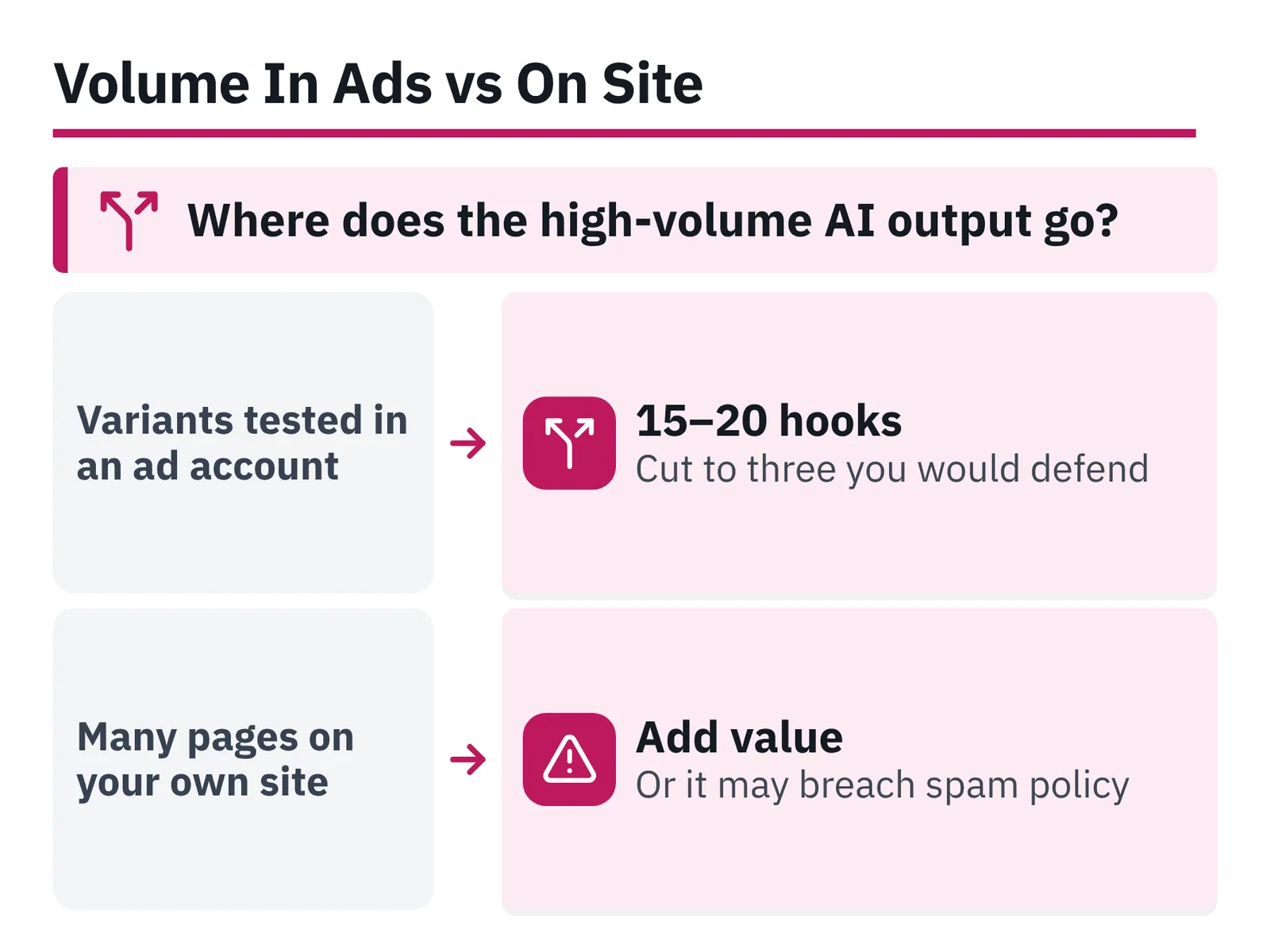
This is where generative AI earns its keep fastest, because top-of-funnel work is volume work with cheap failure. Twenty ad hooks cost you nothing to generate and little to test. Google Search documentation states that using generative AI to publish many pages without adding value for users may breach its scaled content abuse spam policy — so volume on your own site is a different equation than volume in an ad account.
Practical uses that hold up:
- Generate 15–20 hook variants for one paid social concept, then cut to the three you would defend in a meeting.
- Turn a 40-minute webinar into a clip list with timestamps and captions.
- Draft outlines and FAQ blocks from real sales call transcripts, not from the model’s imagination.
- Produce localized versions of a single winning script rather than commissioning five shoots.
The repurposing use case is the one small teams underrate; a repeatable weekly system for turning one recording into short-form clips beats sporadic bursts of AI output. Keep a human on the hook for the claim in every hook.
Middle of Funnel: Personalization, Email, and Lead Nurture
Mid-funnel is where personalization stops being a slogan and becomes a data problem. Generative AI is good at segment-level variation — rewriting one nurture email for a dentist, a law firm, and a SaaS ops lead — and risky at one-to-one invention, where it fills gaps with flattering fiction.
Uses worth building:
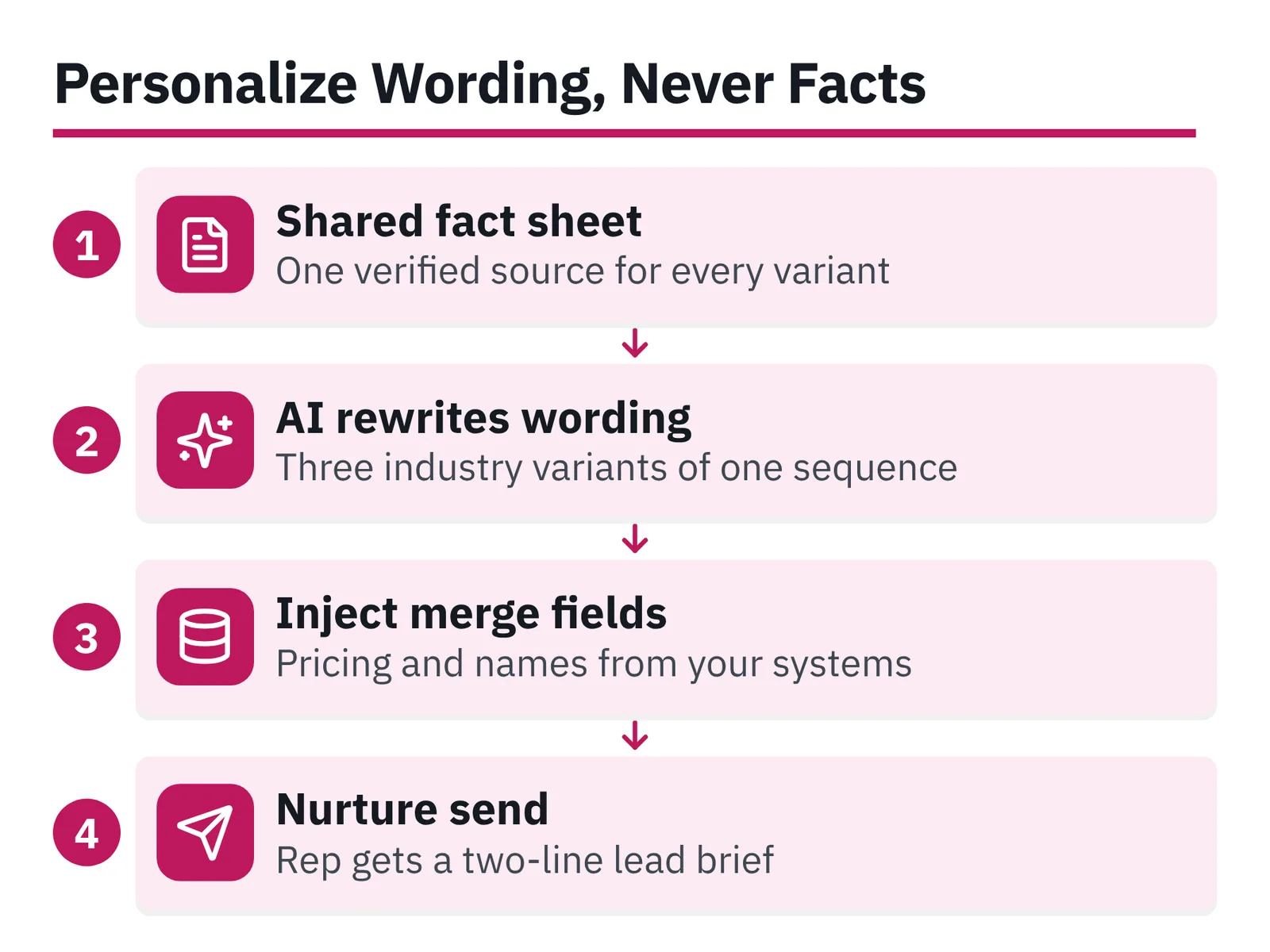
- Rewrite one nurture sequence into three industry variants from a shared fact sheet.
- Summarize a lead’s form answers and last three site visits into a two-line brief for the rep.
- Draft subject line sets for testing, scored against your own past opens rather than the model’s taste.
- Convert a dense case study into a short video script for the follow-up send; the mechanics of making video actually play inside an email matter more than the script quality.
The rule that keeps this safe: a generative model may personalize wording, never facts. Pricing, contract terms, availability, and customer names come from your systems, injected as merge fields. If the model is writing the number, the number is a guess.
Bottom of Funnel and Retention: Sales Enablement, Support, and Win-Back
Late-funnel assets are low-volume and high-stakes, so the pattern flips: fewer drafts, heavier review. Useful jobs include first-draft proposals built from a template plus call notes, objection-handling one-pagers, onboarding and how-to videos, and win-back emails segmented by the reason a customer churned.
Localization is the clearest win. One master script becomes a dozen language versions without a reshoot. AI Studios, DeepBrain AI’s cloud platform for avatar video, text-to-video, and video translation, offers text-to-speech in 150+ languages and accents on paid plans and 30+ languages on its Free plan, which is the kind of range that makes multi-market onboarding video realistic for a small team — see AI Studios for how that workspace is put together.
One hard boundary sits in this part of the funnel. The FTC’s Trade Regulation Rule on the Use of Consumer Reviews and Testimonials, which bans fake and AI-fabricated reviews and testimonials, took effect on October 21, 2024. Generate the request for a review. Never generate the review.
Where the Risks Are: Accuracy, Disclosure Law, Search Penalties, and Brand Safety
Four risks deserve a standing policy, not a case-by-case argument.
Accuracy. Models state wrong facts in fluent sentences. Any price, date, statistic, certification, or legal claim must trace to a source document before it ships.
Disclosure law. The EU AI Act’s Article 50 transparency obligations became enforceable on 2 August 2026, including for non-EU companies whose AI outputs reach EU users. Faegre Drinker reports that non-compliance with the EU AI Act’s transparency obligations can trigger fines of up to €15 million or 3% of worldwide annual turnover. In the US, Alston & Bird reports that violations of the FTC’s fake reviews and testimonials rule can currently carry civil penalties of up to $51,744 per violation, plus consumer redress. Rules differ by jurisdiction, and what satisfies a US advertising expectation may not satisfy an EU transparency obligation.
Search penalties. Google’s own guidance ties mass AI publishing to scaled content abuse, so your blog volume target should be an outcome, not an input.
Brand safety. Synthetic faces, voices, and customer-style testimonials carry reputational risk even when legal — platform policy review is a separate gate, and how AI UGC ads get through that review is worth reading before you brief one.
This section is general information, not legal advice; check your obligations with counsel in each market you sell into.
How to Start: Costs, Guardrails, and Metrics That Prove It Worked
Start with one workflow you already do weekly and already measure. Ad variant production and video repurposing are the usual first picks because the feedback loop is days, not quarters. Company-wide rollouts stall; one team shipping faster does not.
Budget in three buckets: tool subscriptions, the human review time you are adding back, and a small training line so people write usable prompts. Build a shared prompt library with your real brand voice examples attached, and name one person accountable for approving each asset class. A short evaluation of which AI marketing tools suit small teams will save you a month of trials.
Measure like this:
| Metric | What it tells you | Where to read it |
|---|---|---|
| Cycle time per asset | Whether speed is real | Project tool timestamps |
| Variants tested per campaign | Whether volume turned into learning | Ad platform reporting |
| Win rate of AI-assisted variants | Whether quality held | A/B results |
| Edits per draft | Whether prompts are improving | Reviewer log |
| Corrections after publish | Whether your guardrails work | Support and legal tickets |
If cycle time drops and corrections rise, you have not saved anything. Fix review before you add volume.
Frequently asked questions
Will publishing generative AI content hurt my search rankings?
Not automatically. Google’s Search documentation states that using generative AI to publish many pages without adding value for users may breach its scaled content abuse spam policy, so the problem is unhelpful content produced at scale, not the tool. Edit, add first-hand specifics, and set page counts by demand rather than by generation capacity.
Do I have to disclose that marketing content was made with AI?
It depends on where your audience is. The EU AI Act’s Article 50 transparency obligations became enforceable on 2 August 2026, including for non-EU companies whose AI outputs reach EU users, and Faegre Drinker reports fines of up to €15 million or 3% of worldwide annual turnover for non-compliance. Rules differ by jurisdiction; confirm yours with counsel, as this is general information only.
How is generative AI different from the marketing automation I already pay for?
Marketing automation routes assets you already created, using rules, segments, and triggers. Generative AI creates the asset itself from a prompt and source material. Automation fails by sending the right email to the wrong person; generative AI fails by writing a confident, wrong sentence inside the email, which is why every batch needs a named reviewer.
Can I use AI to write customer reviews or testimonials?
No. The FTC’s Trade Regulation Rule on the Use of Consumer Reviews and Testimonials, which bans fake and AI-fabricated reviews and testimonials, took effect on October 21, 2024, and Alston & Bird reports civil penalties of up to $51,744 per violation plus consumer redress. Use AI to draft the request you send real customers instead.
Where should a small team apply generative AI first?
Pick one weekly workflow with a fast feedback loop — usually paid social ad variants or repurposing one long recording into short clips. You get measurable cycle-time and test-volume changes within weeks, the review burden stays small, and a mistake in an ad variant is cheaper to fix than a mistake in a pricing page or a contract.
Sources
- The state of AI in early 2024: Gen AI adoption spikes and starts to generate value — McKinsey
- EU AI Act Article 50 Transparency Obligations Go Live — Baker Botts
- EU AI Act — Commission Confirms Transparency Code of Practice as Adequate — Faegre Drinker
- Trade Regulation Rule on the Use of Consumer Reviews and Testimonials — Federal Register
- FTC Issues Final Rule on Fake Reviews and Testimonials — Alston & Bird
- Google Search’s guidance on using generative AI content on your website — Google Search Central
Written with AI assistance and fact-checked against the sources cited above before the AI Marketings Editorial Team published it.