Use an agency for flagship films, freelancers for recurring shoots you can brief yourself, and AI tools for script-driven volume: explainers, localization and social variants. Most teams run two of the three, not one.
Why marketers are looking for alternatives to traditional marketing video production
Demand for video went up. The way most teams buy it did not. A quarterly brand film booked three months out does not feed a channel that wants weekly cutdowns, two paid variants and a Spanish version by Friday.
Rocketium’s 2026 statistics roundup reports that 91% of businesses use video as a marketing tool in 2026, matching the all-time high in Wyzowl’s annual survey. That volume is the pressure point. The full-service model was built for a handful of hero assets a year, not for a content calendar.
The limits are specific, and they show up in the same three places every time. Lead time measured in weeks rather than days. Revisions billed per round, so rewriting one compliance-flagged line has a price. Localization that means booking a new voice session instead of swapping a track.
Cost is one of the two joint-top reasons businesses give for not doing video marketing in 2026, cited by 24% of non-users, according to Wyzowl data published on the Wix blog. Wyzowl’s 2026 figures on the Wix blog also show 63% of video marketers have used AI tools to create or edit marketing videos, up from 51% in 2025.
Alternatives rarely replace the shoot. They split the calendar into work that needs a camera and work that needs a script.
1. Full-service video production agency
An agency sells you a producer, not just a camera. You are buying scheduling, casting, location permissions, insurance, gear, sound, post and someone whose job is to absorb the chaos when the talent cancels. That coordination is the actual product.
Price it in one unit: cost per finished minute delivered. Ask for that number in the quote, including two revision rounds and the master files, so you can compare a $20,000 brand film against a day-rate freelancer honestly.
Goldcast reports that outsourcing video production to external vendors fell sharply, from 24% of video marketers in 2024 to 14% in 2025. Read that as a shift in what gets outsourced rather than a verdict on agencies.
Switching away from an agency is mostly a rights and assets problem. Before you give notice, get the raw footage, project files, licensed music terms and brand template files in writing. Teams that skip this discover a year later that their own b-roll lives on a hard drive they do not own.
Stay with an agency when the shoot is logistically hard, when talent and locations carry the story, or when a mistake is expensive in public.
2. Freelance videographers and editors
Hiring freelancers means you take the producer’s chair. You write the brief, lock the schedule, own the storage, chase the deliverables and keep a second editor warm for the week your first one gets food poisoning. The savings are real; so is the admin.
According to Wyzowl’s 2025 survey reported by HubSpot, 55% of marketers produce videos in-house, 14% outsource to vendors such as agencies, and 31% use a mix of both. That mixed group is where most freelance relationships sit.
Price shoots as a day rate plus edit cost per finished minute, then add your own hours as a line item. A marketing manager spending six hours a week producing is a cost, even if it never appears on an invoice.
Vetting matters more here than anywhere else. Watch three complete deliverables in your exact format — not a highlight reel — and ask who did the color and sound on each.
Migration difficulty is moderate. You need a one-page brief template, a shared drive with a folder convention, and a named backup editor before the first project, not after.
3. Synthesia
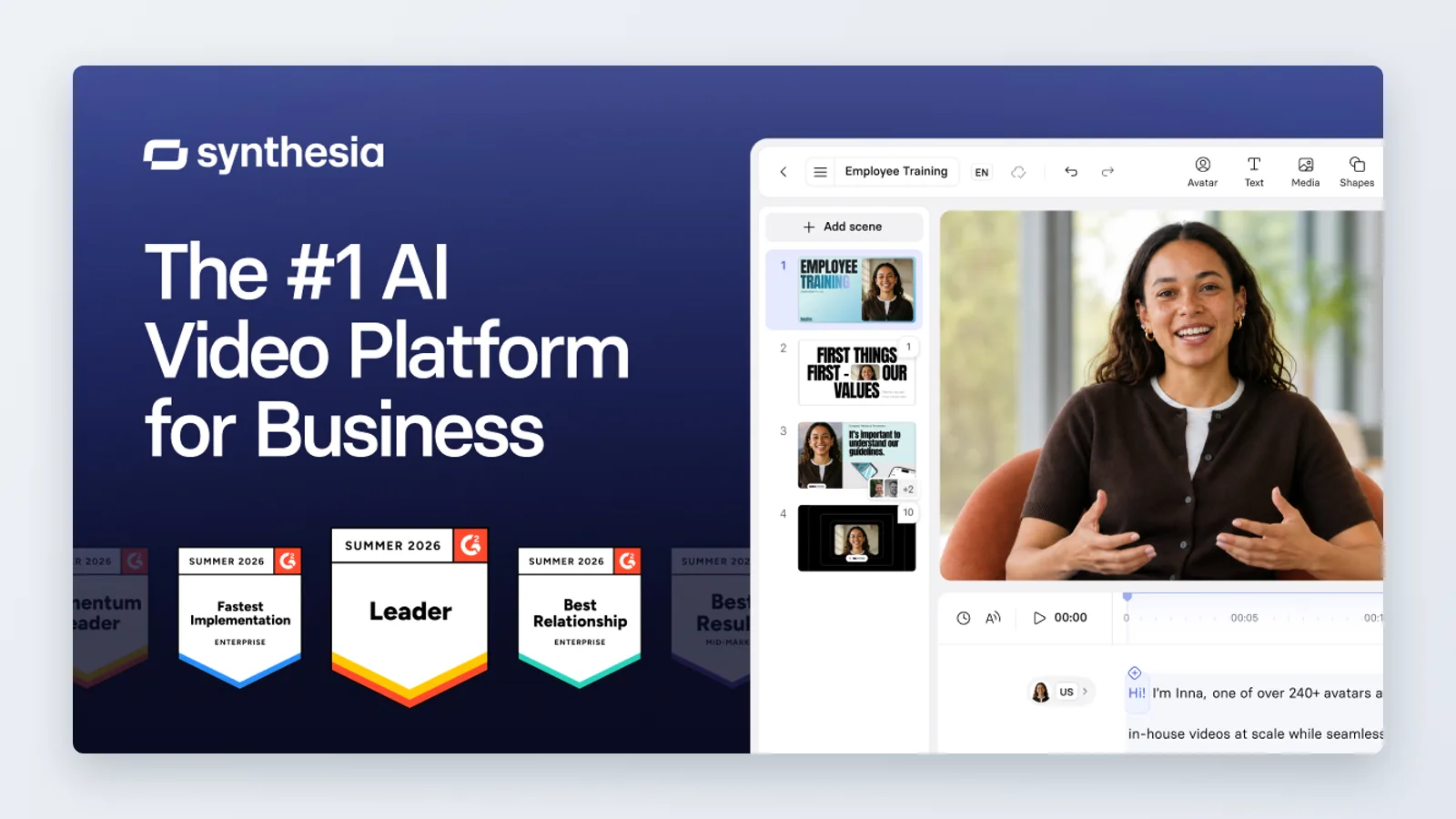
Synthesia is one of the best-known names in the AI avatar video category, where you type or paste a script and get a presenter-led video out the other end. Treat the plan limits, avatar counts and language coverage as things to check on its own pricing page; those specifics were not verified for this article.
The format decides the fit. Avatar video works for explainers, onboarding, product updates, sales enablement and anything where a person talking to camera is enough. It does not work when the message is a physical product being used in a real space.
Convert the cost honestly. Take the seat price per month and divide it by the minutes you actually publish that month, not the minutes the plan allows. Teams that buy a seat and ship two videos a quarter are paying agency-level rates per minute without the agency.
Pilot it on one real script before you commit to a year. Check the pronunciation of your brand name, your product names and any acronym your sales team says out loud. Fix those in the script with phonetic spelling rather than re-recording.
4. AI Studios by DeepBrain AI
AI Studios by DeepBrain AI is a cloud-based platform for creating AI avatar videos, text-to-video content and video translations, and it combines avatar creation, text-to-video, dubbing, text-to-speech and generative AI tools in one workspace. DeepBrain AI is headquartered in Seoul, South Korea, with additional offices in Silicon Valley and Beijing.
One piece of housekeeping first: AI Studios by DeepBrain AI is a video-creation SaaS and is unrelated to Google AI Studio, which is a developer tool for testing language models. People search for the wrong one constantly.
For comparison in seat terms, the Personal plan is listed at $24 per month when billed annually, and annual billing is advertised as saving 20% compared with monthly billing. That plan includes unlimited AI videos up to 30 minutes each, 1080p export, 3 custom avatars, 120 minutes of AI dubbing per month and 60 generative credits per month. Divide that seat cost by the minutes you publish to get your real per-minute number.
Language coverage is the practical reason most marketing teams look here. Text-to-speech voiceovers are available in 150+ languages and accents on paid plans, and in 30+ languages on the Free plan, with more than 1,000 AI voices across plans.
The free tier is a test drive, not a workflow: it costs $0 and allows up to 3 AI videos of up to 1 minute each, exported in 720p, with 16 one-time generative credits. Studio-made stock avatars are listed separately — 40+ on Free, 100+ on Personal, and 155+ on Team and Enterprise.
The limitation is the same one every avatar platform shares. If your video needs a technician’s hands on your hardware, or a customer in their own kitchen, book a freelancer with a camera instead.
5. Canva Video Editor
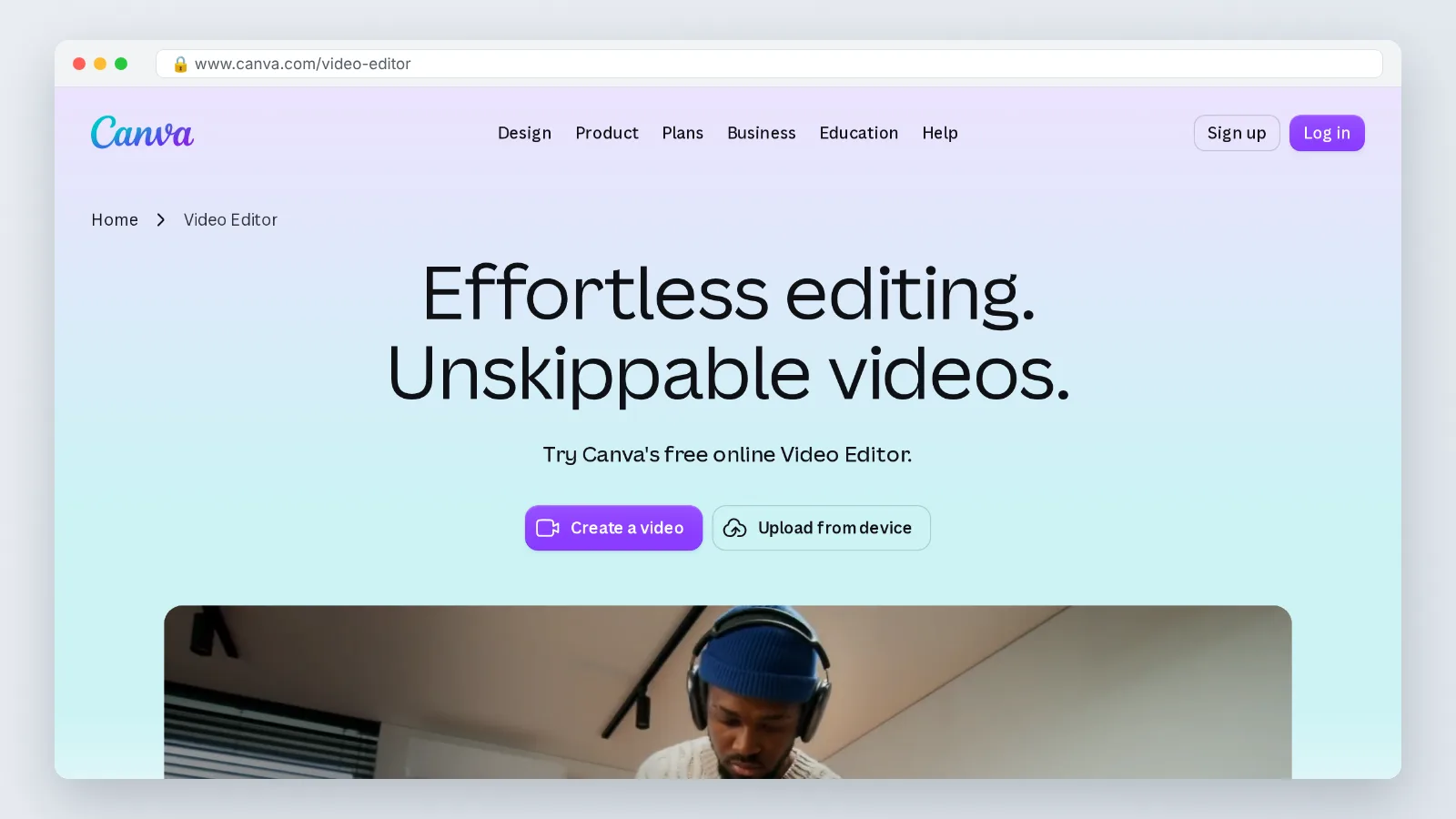
Canva’s video editor is the lowest-friction option for teams that already run their static design there. Your logo, fonts, color palette and product shots are sitting in the same account, so migration cost is close to zero and the learning curve is measured in an afternoon.
Confirm what your current plan actually includes for video before you build a workflow on it; those limits were not verified here and they change.
The realistic job for it is assembly and repurposing. Cutting a long webinar into six vertical clips, adding captions, building a sequence of product stills into a fifteen-second ad, refreshing last quarter’s video with new pricing on screen.
Test the edge cases before you promise anything. Load your longest file, try a multi-track audio mix, and export at the resolution your paid media team demands. If any of those stall, the tool belongs in your social workflow and nowhere near your launch assets.
One person can own this route. That is both its advantage and its ceiling.
Cost, speed and quality: how the three routes compare
Most teams underfund video and then judge the output as if they had not. Wyzowl figures published on the Wix blog show 46% of marketers put a third or less of their marketing budget into video in 2026, and 17% don’t track video spend at all.
| Route | Price it as | Typical turnaround | Switching effort | Weakest at |
|---|---|---|---|---|
| Full-service agency | Cost per finished minute delivered | Weeks, set by the shoot date | High — recover footage, project files, music rights | Cheap iteration and small edits |
| Freelancers | Day rate plus edit cost per finished minute | Days to two weeks | Moderate — you build the brief and storage system | Consistency across many creators |
| AI tools (avatar platform) | Seat cost per month ÷ minutes published | Hours once the script is locked | Low — script in, video out | Anything requiring real footage |
| AI tools (template editor) | Seat cost per month ÷ assets published | Same day for cutdowns | Low if brand assets already live there | Complex audio and color work |
Speed is the cleanest difference. Script-driven tools collapse the gap between a decision and a published video, which is why they absorb localization and update work so well.
Quality is where the trade shows up, and the market is noticing: Rocketium reports that satisfaction with video marketing ROI dropped from 93% in 2025 to 82% in 2026 as production volume rose. More output is not automatically better output.
How we compared these options
This comparison is based on published vendor information and the survey data cited in each section. Pricing and plan details for AI Studios come from DeepBrain AI’s own pricing page as published.
What was not done: no hands-on testing, no side-by-side render comparisons, and no verification of Synthesia’s or Canva’s current plan limits, avatar counts or export options. Check those on the vendors’ pages before you buy, and treat turnaround times in the table as planning estimates, not guarantees.
When to stay with the original
Keep the agency when the thing on screen cannot be synthesized. A surgeon using your device, a chef in a real kitchen, a founder walking the factory floor — those sell because a camera was there, and viewers can tell.
Rocketium reports that 89% of consumers say video quality directly affects how much they trust a brand, which raises the stakes on cheap production shortcuts. A clumsy avatar video on your homepage costs more than it saves.
Time is the other reason to keep outsourcing. Among marketers not using video, HubSpot’s report of Wyzowl’s 2025 data lists lack of time at 26%, uncertainty about video ROI at 16% and perceived high costs at 11%. If nobody on your team has eight free hours a week, an agency is buying back capacity, not just footage.
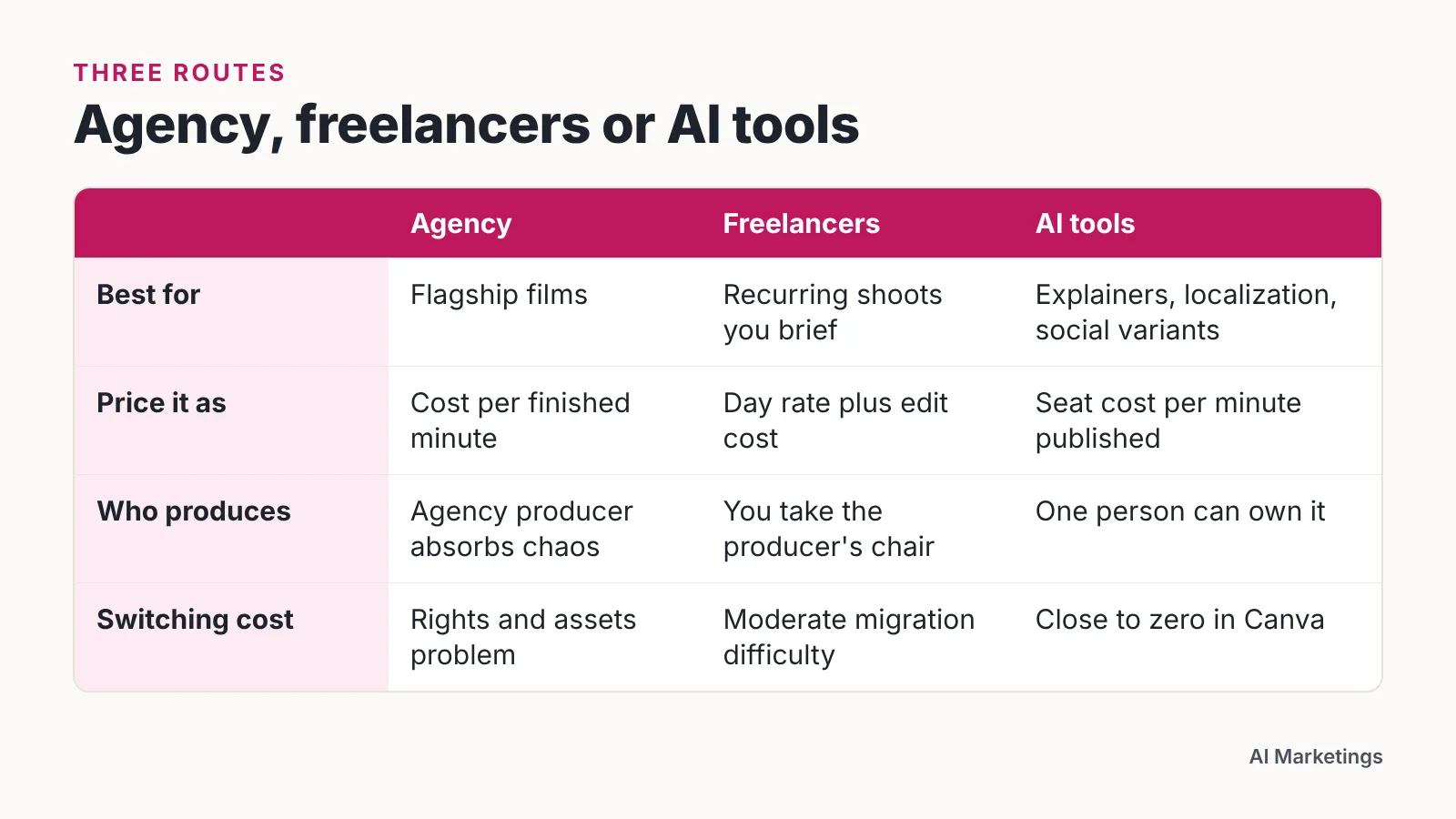
The practical split for most marketing teams looks like this. Agency or senior freelancer for two or three flagship assets a year. Freelancers for recurring shoots you can brief in a page. AI tools for the explainers, updates, language versions and social variants that would otherwise never get made.
Pick the route per asset, not per company.
Frequently asked questions
Is AI video good enough for a product launch film?
Usually not as the hero asset. Rocketium reports that 89% of consumers say video quality directly affects how much they trust a brand, so keep a real shoot for the launch film and use AI tools for the supporting explainers, localized versions and social cutdowns around it.
How should I compare an agency quote with an AI tool subscription?
Convert both to cost per finished minute. For the agency, divide the quote by the minutes actually delivered, including revisions and master files. For a tool, divide the monthly seat cost by the minutes you realistically publish that month, not the minutes the plan permits.
Can I use more than one route at the same time?
Yes, and most teams do. According to Wyzowl’s 2025 survey reported by HubSpot, 55% of marketers produce videos in-house, 14% outsource to vendors such as agencies, and 31% use a mix of both — so a hybrid setup is the normal arrangement, not a compromise.
How hard is it to move from an agency to freelancers?
Plan on four to six weeks of overlap. Before you end the contract, secure raw footage, project files, music license terms and brand template files in writing, then build a one-page brief template, a shared drive with a folder convention and a named backup editor.
Is AI Studios the same thing as Google AI Studio?
No. AI Studios by DeepBrain AI is a video-creation SaaS for AI avatar videos, text-to-video and video translation, while Google AI Studio is a developer tool for testing language models. DeepBrain AI is headquartered in Seoul, South Korea, with offices in Silicon Valley and Beijing.
Sources
Written with AI assistance and fact-checked against the sources cited above before the AI Marketings Editorial Team published it.