Meet-the-dentist, first-visit/fear, cost and insurance, procedure explainers, consented patient stories, an office tour, and a team recruitment clip — seven short videos, filmed in-house, placed on Google Business Profile, YouTube Shorts and treatment pages.
What dental video marketing actually is, and the four jobs video does for a practice
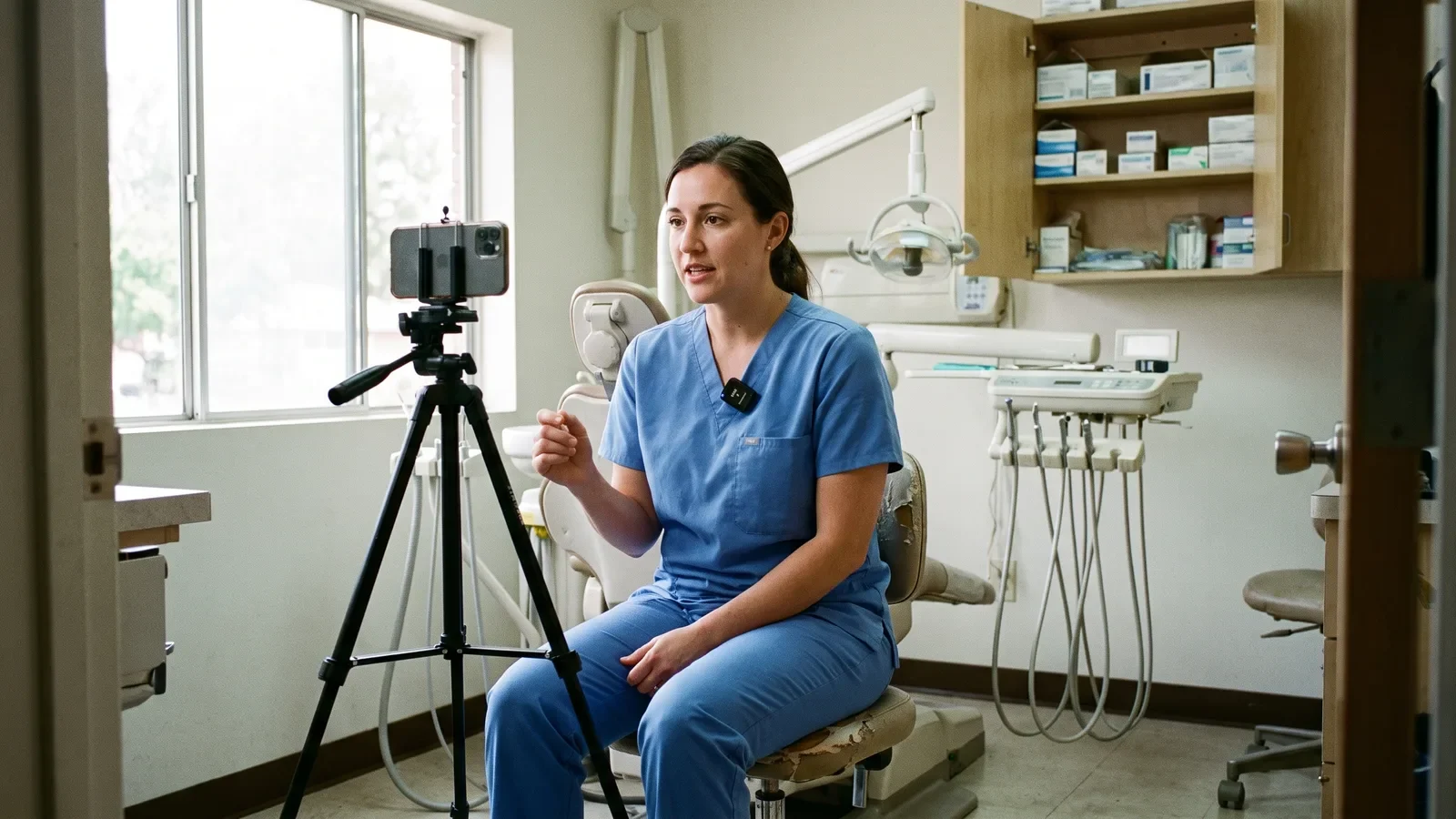
Dental video marketing is a small library of short clips your own team records — most of them 20 to 90 seconds — that answer the questions a nervous adult types into a phone at 10 p.m. It is not a broadcast commercial. It is not a drone shot of the parking lot.
Every clip you publish should do at least one of four jobs:
- Get found. Video attached to your Google Business Profile and treatment pages gives search engines and patients something to watch at the moment they are comparing three names.
- Lower fear. A dentist explaining what a root canal appointment actually feels like removes the imagined version, which is always worse.
- Answer the money question. Fees, insurance, and payment plans are the conversation people avoid starting on the phone.
- Recruit. Hygienists and assistants screen employers the same way patients screen dentists.
The competitive reason to bother is scale. The share of DSO-affiliated dentists nearly doubled from 7.4% in 2015 to 13.8% in 2023, according to the Benevis report Top Trends Shaping Dental Healthcare. Corporate groups buy media; an independent two-doctor office cannot outspend them, but it can out-specific them with a face, a name and a straight answer about cost.
Think of the library as a fixed asset. You film once, and the clip keeps working on your crown page for two years.
How patients choose a dentist online, and the moment video changes the decision
The path is predictable. A tooth hurts or a cleaning is overdue, someone searches "dentist near me," scans the map results, reads three or four reviews, then opens one website. Video rarely wins the search. It wins the last thirty seconds before the call.
The 2024 ADA Trend Report found that 73% of consumers trust Google when choosing a dentist and 59% treat online reviews as critical to the decision, as summarized by Benevis. Those consumer findings come from an online survey of 1,008 consumers fielded in March 2024 with a ±3% margin of error, according to the ADA Communications Trend Report: 2024.
Reviews tell a prospective patient that other people survived your office. Video tells them what *they* will experience. The gap between those two things is where a practice loses bookings — good reviews, no sense of the person holding the handpiece.
Watch the questions your front desk answers twice a day: Does it hurt? Do you take my plan? Can I bring my kid? Each one is a script, already written by your patients.
The 7 videos that win new patients, ranked by effort versus payoff
Rank by how much production each clip needs against how directly it moves someone to book. Start at the top of the table and work down over three months.
| # | Video | Effort | Payoff | Publish first to |
|---|---|---|---|---|
| 1 | Meet the dentist (60–90 sec) | Low | Highest | Homepage, Google Business Profile |
| 2 | Fear and the first visit | Low | High | New-patient page, YouTube Shorts |
| 3 | Cost and insurance explainer | Low | High | Financial page, paid social |
| 4 | Procedure explainers (one per treatment) | Medium | High, slow-building | Each treatment page |
| 5 | Consented patient story | High (consent, scheduling) | High | Treatment page, ads |
| 6 | Office tour | Medium | Medium | Google Business Profile, new-patient page |
| 7 | Team recruitment | Low | High for hiring, not patients | Careers page, Shorts |
The cost video outperforms its effort level. Cost was the top reason given by 36% of respondents who had not visited a dentist in two years, according to the Benevis trends report — so a 45-second clip naming your exam fee structure and financing options speaks to the single largest objection.
Recruitment video earns its slot for a different reason. A 2024 ADA Health Policy Institute survey found almost 72% of dentists called hiring hygienists extremely challenging, and 46% said the same about dental assistants, per Benevis. An empty hygiene chair is a marketing problem too.
Scenario: a two-operatory practice with 14 empty hygiene slots a week
Picture a composite office — one owner-dentist, two operatories, two hygienists working alternating days, a 4.7-star average across 90-odd reviews. Fourteen hygiene appointments go unfilled across a typical week. The phone rings, but roughly a third of callers ask about price and never schedule.
The practice has no video anywhere. The website has a stock photo of a model with unnaturally white teeth. The Google Business Profile has eleven photos, mostly of the waiting room sofa.
The owner collected one agency proposal in spring, filed it, and has been waiting for a quieter quarter since.
Meanwhile the price objection keeps repeating. In 2023, 13% of Americans cited cost as a barrier to dental care, versus 4%–5% for other healthcare services, according to the Benevis report Top Trends Shaping Dental Healthcare. That gap is not a messaging accident; dentistry is the service people assume they cannot afford.
For this office, the first three clips write themselves: the dentist introducing herself, a 30-second answer to "what does a new-patient exam cost here," and a hygienist walking through what a cleaning appointment involves for someone who has stayed away five years. No crew. No agency. One afternoon.
Before versus after: the one-afternoon monthly filming workflow that replaces the ‘someday’ agency plan
The plan below is an illustrative workflow, not measured results from a real office.
| Before | After | |
|---|---|---|
| Published videos in the last 11 months | 0 | 6 per filming afternoon |
| Production time | Indefinite — awaiting proposal | 3 hours, once a month |
| People involved | External crew, 4+ schedules | Dentist, one hygienist, one phone |
| Clips live on treatment pages | 0 | 4 within the first quarter |
| Front-desk price calls answered before ringing | 0 | 1 standing clip on the financial page |
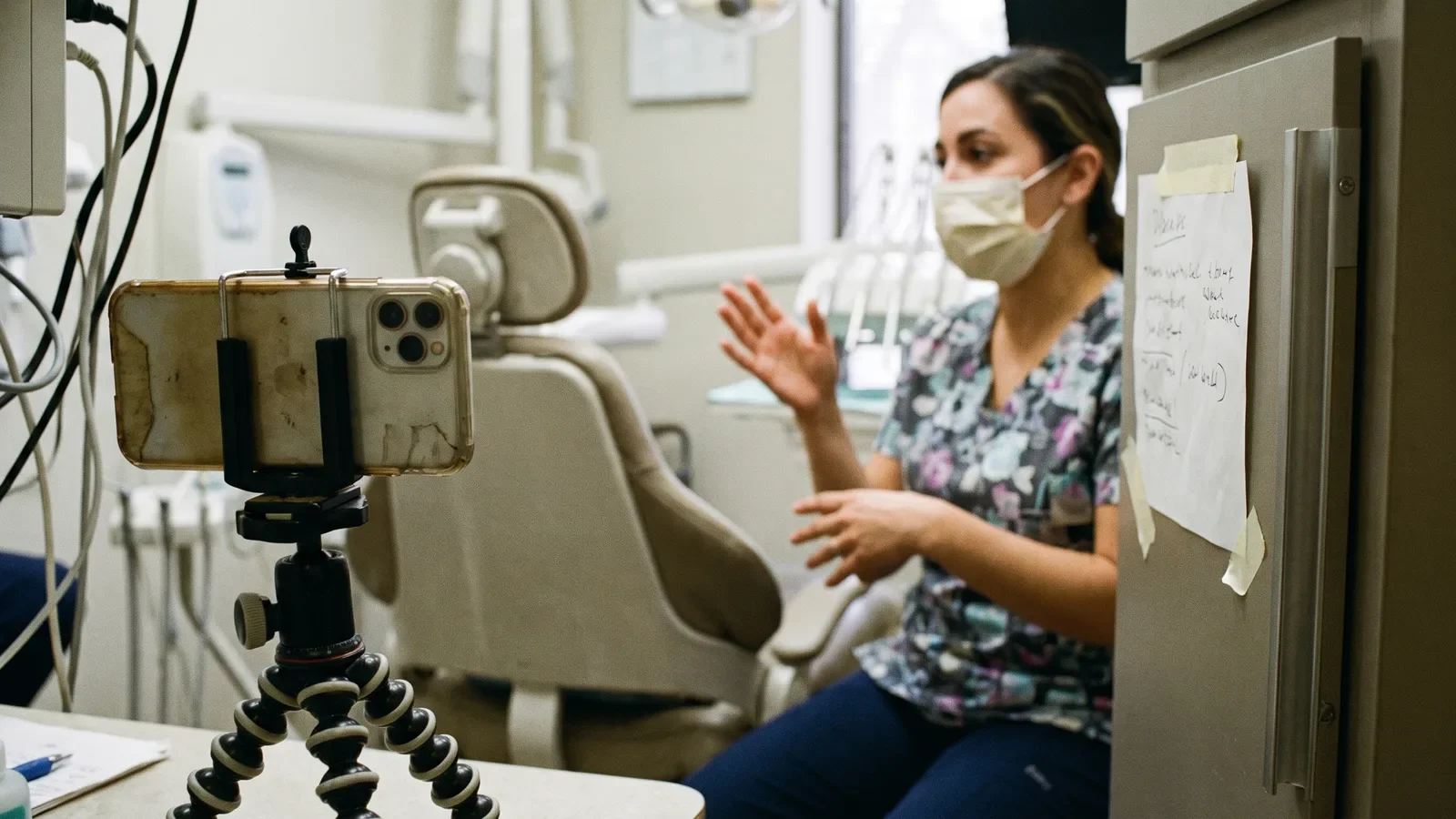
The mechanics are mundane. Block the last three hours of one admin afternoon, set a phone on a tripod in an operatory with the window on the subject’s left, and shoot six topics back to back in scrubs you are already wearing.
Batching is what makes this survive month four. Changing clothes, lighting and mental gear once per month costs less than six separate "we’ll film Thursday" attempts that never happen.
Keep a running list of patient questions on the front desk schedule so the next filming day never starts with a blank page.
Reproducible procedure: script, film, caption and publish one 30-second patient-question video in 45 minutes
Use one patient question per clip. Run the steps in order.
- Pick the question (3 minutes). Take the one your front desk answered most this week.
- Write the script (10 minutes). Aim for under 80 words — roughly 30 seconds spoken. Structure: the question, the direct answer, one reassurance, one next step.
- Set up (5 minutes). Phone horizontal for the site, vertical for Shorts; subject three feet from a window; lavalier mic clipped at the sternum.
- Film (10 minutes). Three takes, no more. Look at the lens, not the screen.
- Caption and trim (12 minutes). Burn in captions, cut dead air at both ends, export at 1080p.
- Publish and log (5 minutes). Upload, then note the date and topic in your tracking sheet.
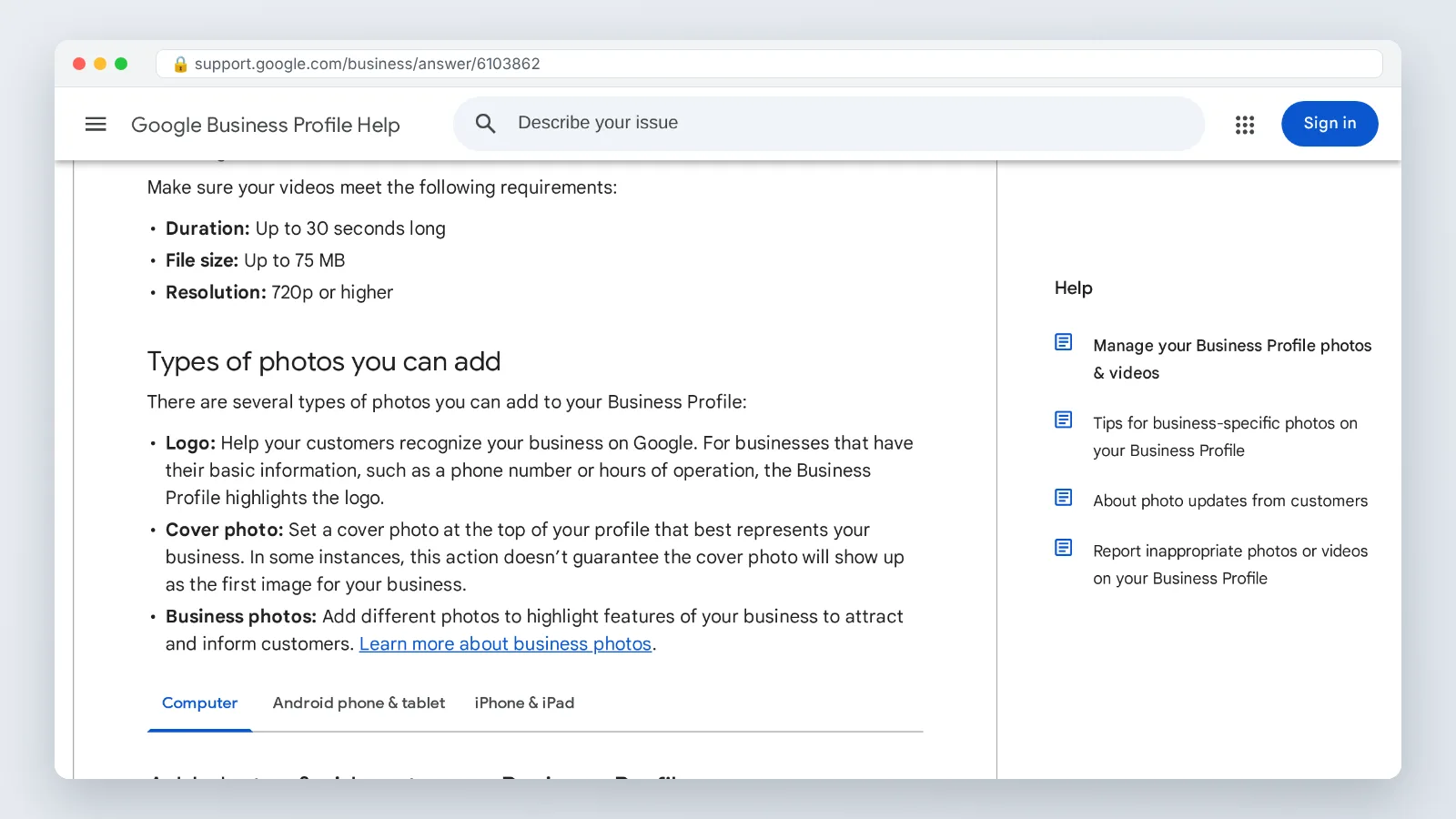
Google Business Profile videos must be no longer than 30 seconds, no larger than 75 MB, and at least 720p resolution, according to Google Business Profile Help — so check the file size before you upload, not after.
For clips where nobody wants to be on camera — insurance terminology, post-op instructions, appointment policy updates — a scripted avatar video is a reasonable substitute. AI Studios, DeepBrain AI’s platform for AI avatar and text-to-video content, can build a video from a script, a topic prompt, a web URL or an uploaded document, and it supports voice cloning from a short recording. Its limitation here is obvious: for meet-the-dentist and patient-story clips, the real clinician’s face is the entire product, and an avatar will not carry that.
Where each video goes: Google Business Profile, YouTube Shorts, treatment pages and ads
One clip, several homes — but the specs differ, so cut accordingly.
| Placement | Format | Hard limits | Best clips |
|---|---|---|---|
| Google Business Profile | Horizontal or vertical | 30 sec max, 75 MB max, 720p minimum (Google Business Profile Help) | Meet the dentist, office tour |
| YouTube Shorts | Square or vertical | Up to three minutes | Fear, cost, procedure explainers |
| Treatment pages | Horizontal, embedded above the fold | None, but keep under two minutes | Procedure explainers, patient stories |
| Paid social and search ads | Vertical with captions | Platform-dependent | Cost, consented stories |
Since October 15, 2024, any square or vertical video up to three minutes long is automatically categorized as a YouTube Short, according to YouTube Help — which means your three-minute crown explainer no longer has to be chopped in half to qualify.
Embed the matching clip on the page that sells the treatment, not on a general "videos" page nobody visits. A patient reading about implants should see the implant video there, in that scroll.
Name your files and titles the way patients speak: "what does a dental implant cost" beats "Practice Video 4 Final v2."
Consent, HIPAA and claims: the pre-publish checklist and three numbers to track for 90 days
In the United States, HIPAA applies to covered entities — including most dental practices that transmit health information electronically — and a patient’s image, voice and treatment details in a testimonial are protected health information. A signed HIPAA authorization, separate from a generic photo release, is the baseline. State rules add layers: several states regulate dental advertising claims and testimonial disclaimers through their dental boards, so check your own board’s advertising rules before publishing.
Run this list before anything goes live:
- Signed, dated HIPAA authorization naming the specific channels and an expiration date
- No other patient, chart, schedule screen or identifying detail visible in the frame
- No guarantee language ("pain-free," "permanent," "best in the city")
- Fees described as ranges or starting points, with the date they were accurate
- Staff on camera have signed a media release
- A stated process for honoring a withdrawal of consent
Track three numbers for 90 days, measured the same way each month: calls generated from your Google Business Profile, new-patient form submissions from pages with an embedded video, and your hygiene schedule fill rate. Compare month three with the baseline month, not with last week.
This is general information, not legal, medical or financial advice — have your attorney review your consent forms and ad claims.
Frequently asked questions
How long should a dental marketing video be?
Match the placement. Google Business Profile videos must be no longer than 30 seconds, no larger than 75 MB, and at least 720p, according to Google Business Profile Help, while square or vertical uploads of up to three minutes count as YouTube Shorts per YouTube Help.
Do I need written consent to post a patient testimonial?
Yes. In the United States, a patient’s image, voice and treatment details are protected health information for HIPAA-covered dental practices, so get a signed, dated authorization naming each channel and an expiration date. State dental boards add their own advertising rules. This is general information, not legal advice.
Should the dentist appear on camera, or can staff handle it?
The dentist should front the meet-the-dentist and fear clips, because patients are choosing a person. Hygienists work well for cleaning walkthroughs and recruitment, and the office manager is the right face for insurance and payment explainers.
Why is a cost video worth filming before a fancy office tour?
Cost was the top reason given by 36% of respondents who had not visited a dentist in two years, according to the Benevis trends report, and in 2023 13% of Americans cited cost as a barrier to dental care versus 4%–5% for other healthcare services.
Can AI avatar videos replace filming the dental team?
Only for some clips. AI Studios can generate a narrated avatar video from a script, topic prompt, web URL or uploaded document, which suits policy and post-op explainers, but meet-the-dentist and consented patient stories depend on the real person’s face and voice.
Sources
- Manage your Business Profile photos & videos – Google Business Profile Help
- Understand three-minute YouTube Shorts – YouTube Help
- Top Trends Shaping Dental Healthcare — Benevis
- ADA Communications Trend Report: 2024 — American Dental Association
- Trends Shaping the Future of Oral Health — 2024 Dental Report (Benevis)
Written with AI assistance and fact-checked against the sources cited above before the AI Marketings Editorial Team published it.