Concrete ai in marketing examples include AI-generated ad creative variations, Google’s Performance Max automated media buying, and Klarna’s OpenAI assistant, which OpenAI reports did the work of 700 full-time agents.
Quick steps before you copy anyone’s playbook
Most roundups of AI marketing describe a tool, not a campaign. The three examples in this piece each have a named platform, a published workflow, and numbers the operating company put its name to. Start with the sequence below, then read the detail.
- Pick one bottleneck — ad creative, media buying, or customer conversations — and work only on that for a week.
- Define the control first: the campaign, the audience, and the one metric you will compare against.
- Generate three to five variants of an asset that already converts, instead of inventing a new concept.
- Ship the AI-assisted version and the human-made version into the same channel in the same week.
- Read results at two weeks, not day three, and log hours saved alongside cost and conversions.
That sequence matters because the failure mode is rarely bad output. It is launching six new things at once and never knowing which one moved the number. The ten-step procedure later in this article expands steps 3 and 5 into a day-by-day build.
What counts as an AI marketing example (and what’s just hype)
A usable example names the company, the platform, the workflow, and who published the result. Everything else is a demo. Use this filter before you copy anything:
| Test | Real example | Hype |
|---|---|---|
| Who ran it | A named brand or advertiser | "Brands are seeing…" |
| What changed | A specific workflow step | "AI-powered transformation" |
| Number source | The platform or company, on the record | An unsourced percentage |
| Reproducible | You could run it this month | Needs a custom model team |
Google’s own case example passes that filter: the insurer Allianz worked with agency Jellyfish on Performance Max and lifted qualified car insurance leads by 15% at a lower cost per lead than generic Search campaigns, according to Google. You can check each element — named advertiser, named agency, named campaign type, named metric.
The hype category usually fails on the third row. A percentage with no publisher attached is a marketing asset, not evidence. If you are still mapping the territory, this field guide to generative AI for marketing separates the content-generation use cases from the targeting and automation ones.
Example 1: AI-generated ad creative at scale — the asset-variation workflow
The most common production use of AI in marketing is not writing new ads. It is multiplying one proven ad into every size, language and hook a channel needs. The workflow is boring and repeatable:
- Take one ad that already beat your baseline over at least two weeks.
- Hold the offer and the proof point fixed; vary only the hook, the opening visual, and the aspect ratio.
- Produce horizontal, vertical and square versions of every video asset.
- Produce the same script in your two or three biggest customer languages.
- Keep a naming convention that encodes variant, ratio and language, so reporting stays readable.
That ratio step has a number behind it. Google’s internal data shows Performance Max advertisers supplying horizontal, vertical and square video versions delivered 20% more YouTube conversions than horizontal video alone. One shoot, three exports, measurable difference.
Avatar and text-to-video platforms fit here because they remove the reshoot. AI Studios, DeepBrain AI’s cloud platform for AI avatar videos and translations, can build a video from a script, a topic prompt, a product page or a URL, and offers text-to-speech voiceovers in 150+ languages and accents on paid plans. For the static side of the same job, this comparison of AI tools for Facebook and Instagram ad creatives covers image variation workflows for ecommerce catalogs.
Example 2: AI-managed media buying — what Google’s Performance Max numbers actually claim
Performance Max is the clearest mass-market example of AI deciding where your money goes. You supply assets, conversion goals and signals; the system allocates across Search, YouTube, Display, Discover, Gmail and Maps. Read the vendor’s claims precisely, because each one has a condition attached.
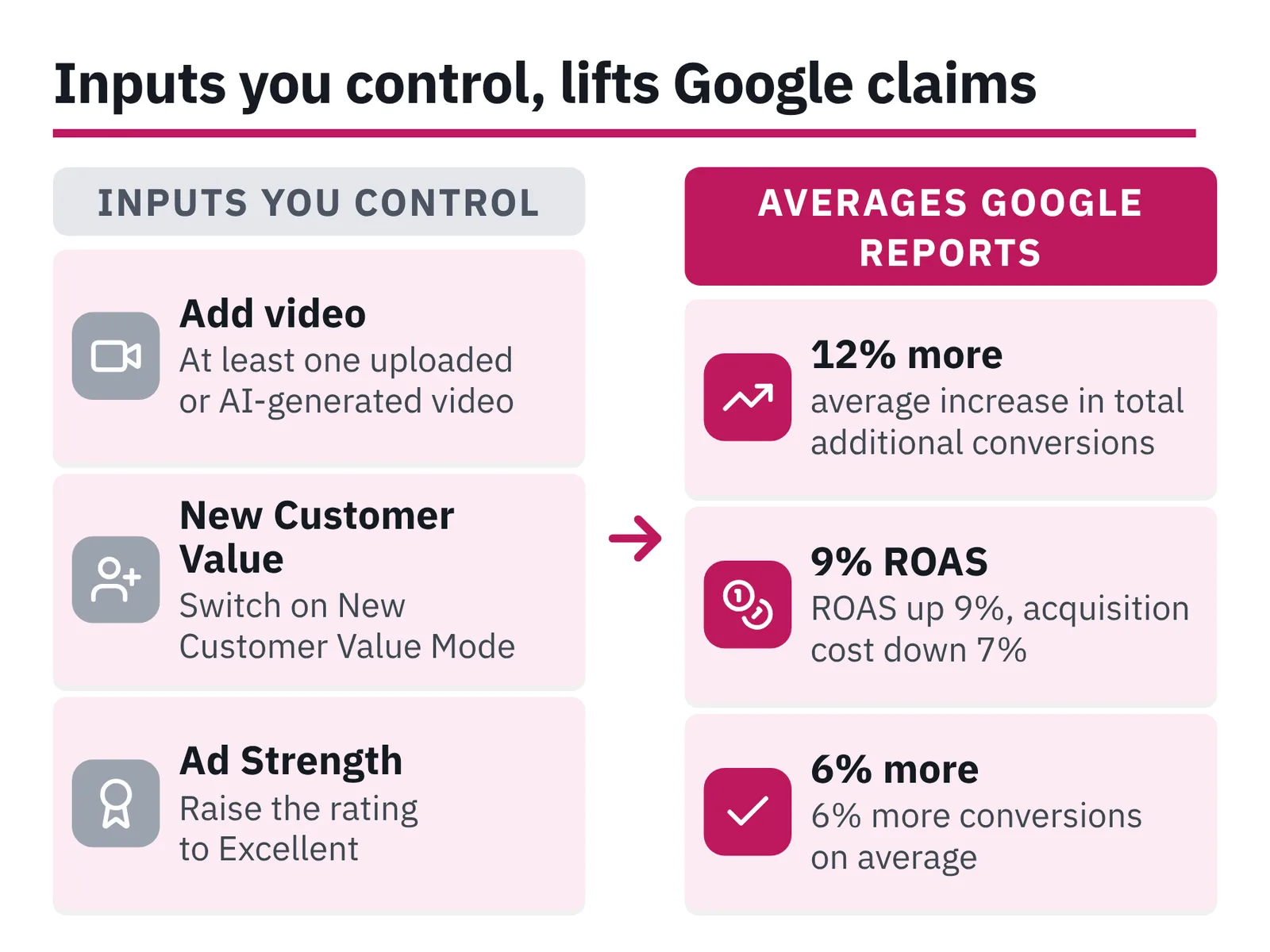
- Google reports that advertisers who add at least one video to Performance Max campaigns — uploaded or AI-generated by Google — see an average 12% increase in total additional conversions.
- Google reports Performance Max advertisers using New Customer Value Mode improved ROAS by 9%, improved new customer ratio by 5%, and reduced new-customer acquisition cost by 7%.
- Google says advertisers who raise their Performance Max Ad Strength rating to "Excellent" see 6% more conversions on average.
Notice what those sentences do not say. They are averages across advertisers who already adopted the feature, published by the company selling the feature. An average that includes thousands of accounts tells you the direction is plausible; it does not predict your account.
The practical read: the lifts Google attributes to video assets, New Customer Value Mode and Ad Strength all come from things you control on the input side. That is where your week should go.
Example 3: AI customer conversations as a marketing channel — the Klarna assistant, by the numbers
Support is a marketing surface. Every resolved question is a retained customer, and every slow reply is a refund request forming. Klarna’s deployment is the most documented example of AI handling that surface at scale.
Klarna’s OpenAI-powered AI assistant was doing the equivalent work of 700 full-time customer service agents, according to OpenAI. The speed change is the part that reads as marketing: after deploying its AI assistant, Klarna customers resolved their support errands in under 2 minutes versus 11 minutes previously, OpenAI reports.
You are not Klarna. The transferable pattern is narrower and still useful:
- Pull your 20 most frequent pre-purchase questions from chat and email logs.
- Write approved answers for each, with the exact claims your legal or compliance reviewer accepts.
- Connect the assistant to order status and shipping data, which is where most "where is it" volume sits.
- Route anything about refunds, complaints or health and safety claims straight to a person.
- Review transcripts weekly and move new recurring questions into the approved set.
An assistant that answers sizing, shipping and returns questions in seconds is a conversion tool, measured in checkout completion rather than ticket counts.
Scenario in focus: a four-person DTC brand launches a seasonal promo
Example (hypothetical): a four-person skincare brand — founder, marketer, customer support lead, part-time designer — runs a two-week seasonal promo. Here is how the same launch looks before and after an AI-assisted workflow.
| Step | Before | After |
|---|---|---|
| Creative | One horizontal video, one static set | One script, three ratios, two languages |
| Production time | Shoot day plus designer queue | Script-to-export in the same day |
| Media buying | Manual budgets across two channels | Performance Max plus one manual control campaign |
| Support | Inbox answered between tasks | Top 20 promo questions auto-answered, refunds escalated |
| Measurement | Platform dashboard only | Holdout audience, post-promo revenue check |
The before/after that matters is throughput, not polish. The old flow produces two assets and spends the week in production; the new flow produces a dozen and spends the week reading results. Google’s reported 12% average lift in total additional conversions for Performance Max campaigns with at least one video is what the extra ratio work is aiming at — not a promise, a target. If your team is picking a stack for this, the roundup of AI marketing tools built for small teams in 2026 is a shorter path than trialing nine products.
The reproducible procedure: a ten-step, one-week AI campaign build
Run this in order. Each step has an owner and an end-of-day artifact.
- Monday morning: pick the single conversion metric this campaign owns — purchases, qualified leads, or booked calls.
- Monday afternoon: choose the control. Keep one existing campaign untouched for the whole two weeks.
- Tuesday morning: pull your best-performing ad from the last 90 days and write down why it worked.
- Tuesday afternoon: draft five hook variants of that ad, same offer, same proof point.
- Wednesday morning: produce each approved hook in horizontal, vertical and square versions.
- Wednesday afternoon: generate your two highest-volume language versions and have a native speaker review them.
- Thursday morning: load assets, check Ad Strength, and fix every "low" signal the platform flags.
- Thursday afternoon: write the 20 approved answers for your chat assistant and set the escalation rules.
- Friday morning: launch with a documented budget split between the AI-assisted campaign and the control.
- Friday afternoon: write the measurement note — what you expect, what would count as failure, when you will look.
Step 10 is the one teams skip and the one that makes the week worth repeating. A pre-registered expectation stops you from rewriting the goal after the fact. For the video pieces in steps 5 and 6, a weekly system for short-form video keeps the pipeline running after launch week ends.
Measuring it honestly: the control group, the metrics, and the vendor-number trap
The trap is treating a platform average as a forecast. Google states that, beyond retail, advertisers adopting its AI-driven Performance Max campaigns see an average 27% increase in conversions or conversion value at a similar CPA or ROAS — a figure published by Google about advertisers who chose to adopt the product. Self-selection, averaging and the publisher’s interest all sit inside that number.
What to do instead:
- Hold out an audience. Exclude a defined segment — a region, a list, or a percentage of traffic — from the AI-assisted campaign for the full test window.
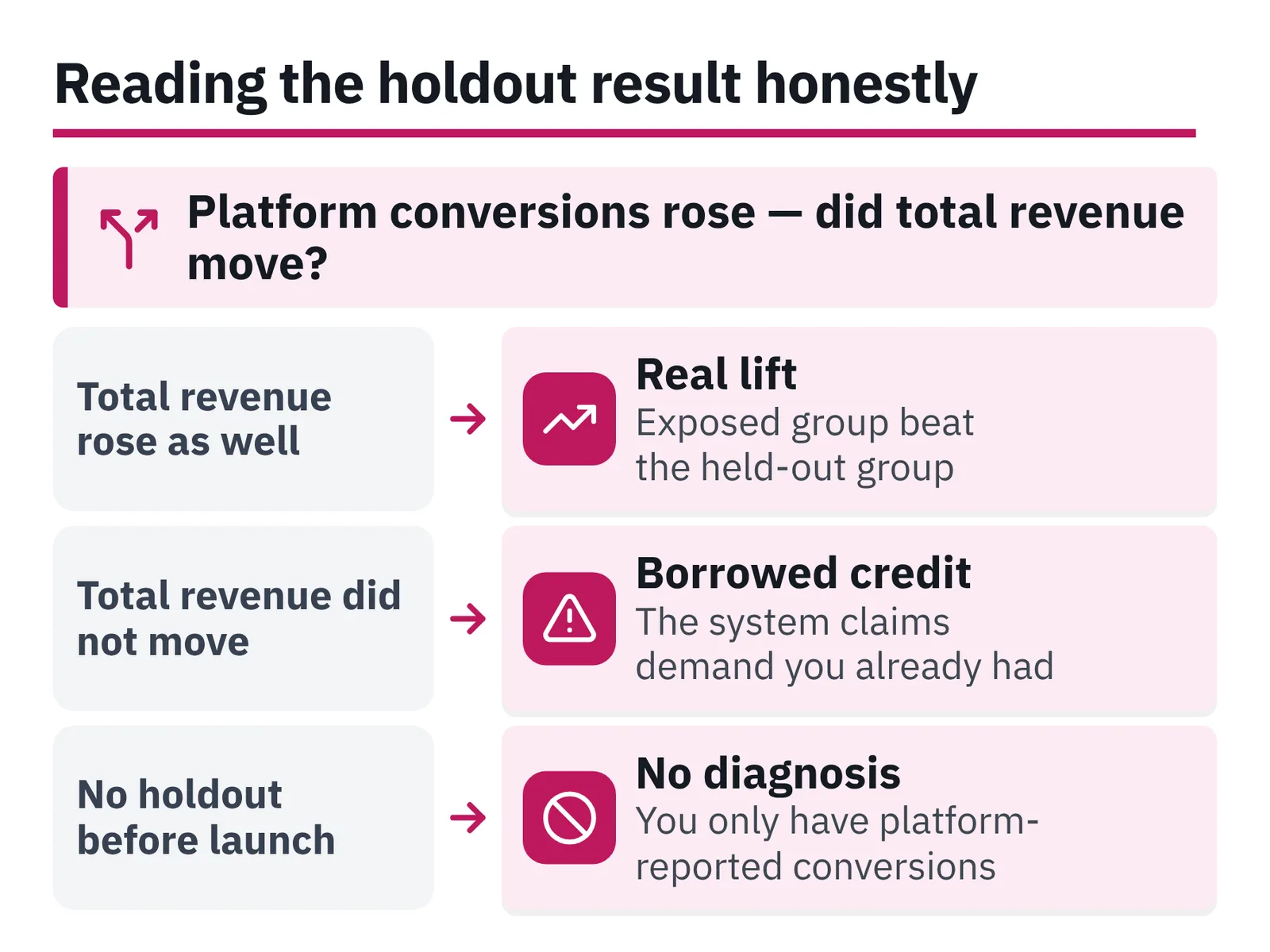
- Measure incrementality, not attribution. Compare total revenue or leads between the exposed and held-out groups, not platform-reported conversions.
- Log hours. Production time saved is a real return even when conversion lift is flat.
- Set a minimum window. Two weeks or one full purchase cycle, whichever is longer.
- Record the counterfactual. Write down what the control campaign did in the same period, in the same document.
If your platform-reported conversions rise but total revenue does not move, the system is probably claiming credit for demand you already had. That diagnosis is only available if you built the holdout before launch.
When AI marketing backfires: brand safety, disclosure, and the human-handoff rule
Three failures account for most of the damage. Generated creative that misstates a product claim. An assistant that improvises a refund policy. A translated script that lands differently in the target market than it reads in English.
Guardrails that prevent each:
- Claims register. Keep an approved list of product claims; nothing generated ships with a claim outside it.
- Human handoff rule. Route refunds, complaints, health claims, legal questions and anything emotional to a person on the first message, not the third.
- Native review. Every localized asset gets read by someone who speaks the language, before launch.
- Disclosure check. Label synthetic presenters and AI-generated endorsements where the platform or the law requires it.
Disclosure rules differ by jurisdiction. In the United States, advertising-disclosure expectations are enforced by the Federal Trade Commission; in the EU, separate AI transparency and advertising rules apply; individual ad platforms layer their own synthetic-media labeling policies on top. Check the current version of each before you launch, because platform policy changes faster than statute. The guide to making AI UGC ads that pass policy review covers the ad-platform side in detail.
This is general information, not legal advice.
Frequently asked questions
What is the clearest recent example of AI in a marketing campaign?
Klarna’s OpenAI-powered assistant is the best-documented one. OpenAI reports it was doing the equivalent work of 700 full-time customer service agents, and that customers resolved support errands in under 2 minutes versus 11 minutes previously.
Does AI-managed media buying like Performance Max actually improve results?
Google reports averages, not guarantees: a 12% increase in total additional conversions for advertisers adding at least one video, and a 6% conversion lift for those reaching an "Excellent" Ad Strength rating. Run a holdout audience to check your own account.
How many creative variants should I generate for one campaign?
Start with three to five hook variants of one asset that already converts, then export each in horizontal, vertical and square. Google’s internal data shows advertisers supplying all three ratios delivered 20% more YouTube conversions than horizontal video alone.
Can a small team run these examples without a specialist?
Yes, if you limit scope to one bottleneck per week. A four-person team can script, generate, localize and launch inside five working days using the ten-step build in this article, provided someone owns the measurement note on day five.
How do I avoid being misled by vendor statistics?
Check who published the number and which advertisers it covers. Google says non-retail advertisers adopting Performance Max see an average 27% increase in conversions or conversion value at similar CPA or ROAS — an average across self-selected adopters, not a prediction for you.
Sources
- Klarna’s AI assistant does the work of 700 full-time agents | OpenAI
- Multiply conversions with Performance Max – Google Ads Help
- Best Practices to Multiply Conversions with Performance Max – Google Ads
- Multiply conversions with Performance Max – Google Ads
- Performance Max campaigns launch to all advertisers | Google Blog
- Google Ads Performance Max Image Generation Now Available To All – Search Engine Journal
Written with AI assistance and fact-checked against the sources cited above before the AI Marketings Editorial Team published it.