Short answer to what are ugc ads: paid ads built from customer- or creator-style content — handheld video, demos, testimonials — that often beat polished brand films because they read as a recommendation inside the feed, not an interruption.
Key takeaways
- UGC ads are a buying motion, not a filming style: you put media spend behind content shot by a customer or creator, usually from their own handle, with their permission.
- The performance case is documented by the platforms themselves — TikTok’s Ads Help Center reports Spark Ads deliver a Completion Rate +30%, Engagement Rate +142%, CVR +43% and CPM -4% versus non-Spark ads.
- Creator footage dominates the top of the spend charts: TikTok’s Spark Ads Creative Playbook, as reported by Parah Group, found 87% of the top 200 highest-spending Spark Ads in a 2023 analysis used creator posts rather than brand-account posts.
- Two rules decide whether your UGC program is safe: platform permission before the ad runs, and FTC disclosure and incentive rules in the United States.
Why UGC ads matter right now for small marketing budgets
Paid social rewards creative volume, and volume is exactly where a five-person marketing team gets squeezed. One studio shoot produces a hero film and a handful of cutdowns, all sharing the same opening frame. A single creator brief can produce a dozen different hooks, three use cases and a month of testing material.
The spend data points the same direction. TikTok’s Spark Ads Creative Playbook, as reported by Parah Group, found that in a 2023 analysis of the top 200 highest-spending Spark Ads, 87% used creator posts rather than brand-account posts. Advertisers with the largest budgets are choosing creator footage over brand-account footage at that rate.
Budget math matters too. A UGC asset is usually priced per video or per usage window, which means your cost per tested variation drops instead of your production value rising. That trade suits a small business selling a $40 product far better than a glossy film does.
If you already publish organically, you have a head start — a weekly system for filming and shipping short clips gives you a library of candidates to promote instead of a blank brief.
How UGC ads work: from an organic post to a paid placement
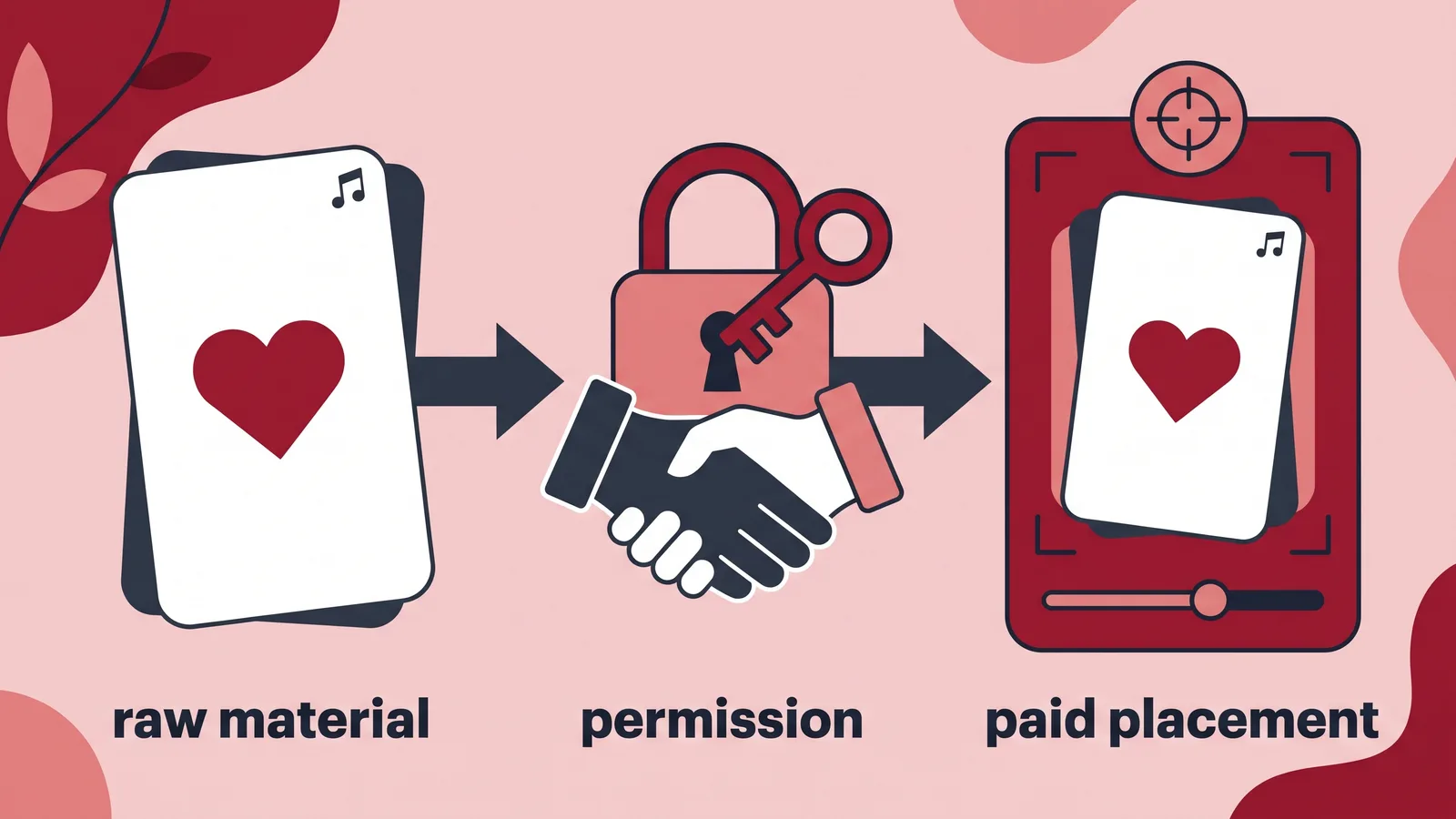
The mechanism is simple once you separate the three things that happen: the content exists, the brand gets rights, the platform turns the post into an ad unit.
The content exists first
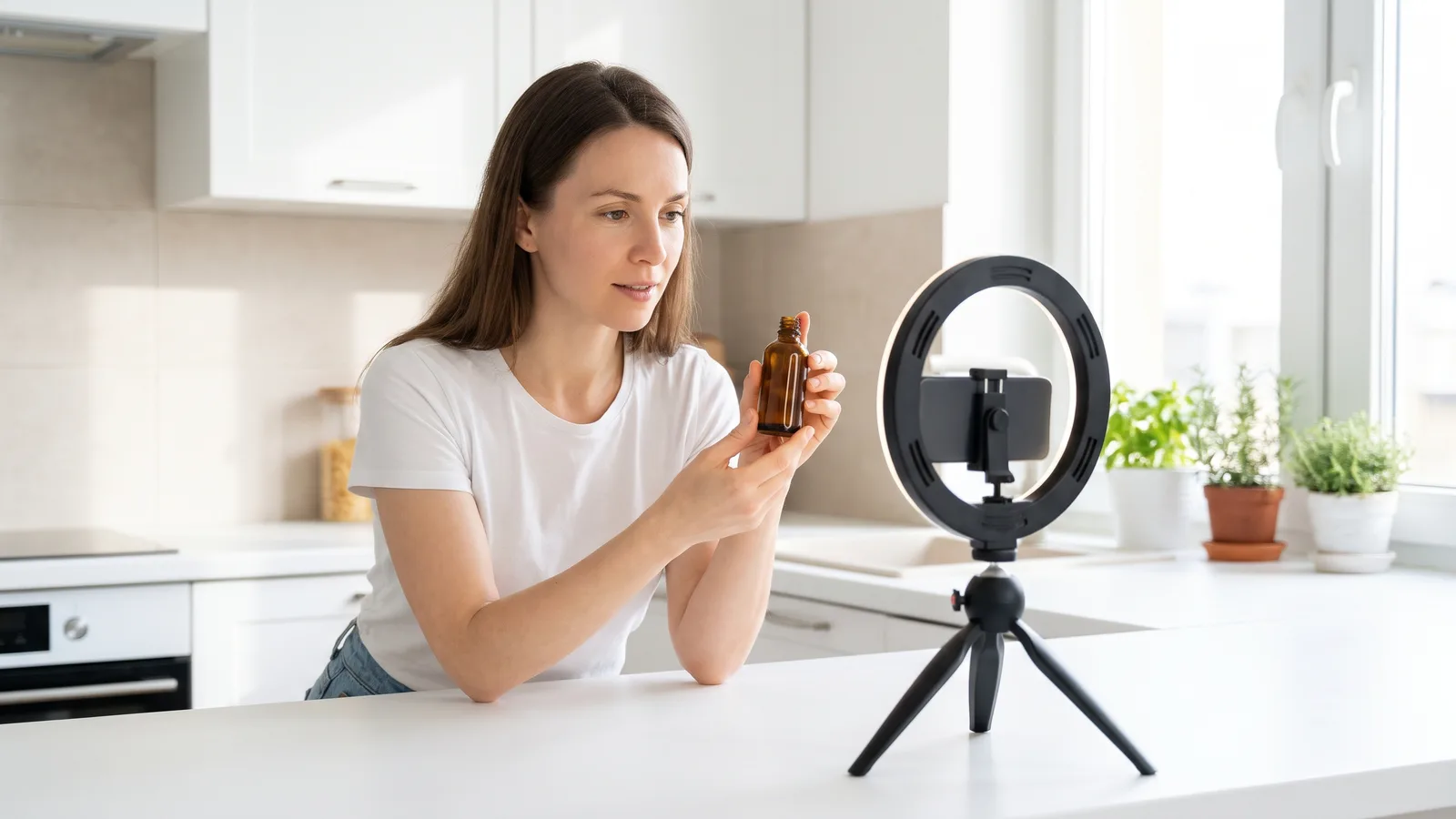
A customer posts a review. A paid creator delivers a vertical video to your brief. A staff member films a demo on a phone. None of this is an ad yet — it is raw material with a native, unpolished grammar.
The brand gets permission
This is the step people skip, and it is the one that stops campaigns. Running a UGC video as a TikTok Spark Ad requires permission to the TikTok account that posted it, which the brand grants through Business Center before the post can be used in ads, according to TikTok’s Ads Help Center. Other platforms run their own authorization flows, so read the help center of whichever platform you are buying before you promise a client a launch date.
The post becomes an ad
Once authorized, the organic post runs as a paid placement — frequently from the creator’s handle, carrying its original comments, likes and sound. Your targeting, budget and optimization goal sit on top. The viewer sees a post; the auction sees an ad.
Any deeper production question — scripting, hooks, policy review — belongs in a dedicated guide, not here; start with the walkthrough on making UGC-style ads that pass policy review.
Why UGC ads often outperform polished brand ads
Four mechanics explain most of the gap, and only one of them is about production cost.
Feed-native format. A handheld clip shares the same visual language as the posts around it, so the viewer does not make the instant "this is an ad" judgment that kills a thumbstop.
Social proof carried into the ad. When the post keeps its original handle, comments and like count, the viewer is reading a recommendation with a receipt attached rather than a brand claim.
Specificity. Creators say the awkward, concrete things a brand team edits out: the tube is smaller than expected, the app’s export takes a minute, the sauce is spicier than the label suggests.
Measured lift. TikTok’s Ads Help Center reports that Spark Ads — paid ads built from organic posts, usually creator videos — deliver a Completion Rate +30%, Engagement Rate +142%, CVR +43% and CPM -4% compared with non-Spark ads. Treat that as platform-reported data for one ad format on one platform; secondary write-ups cite much larger completion-rate lifts from a different TikTok test, which is why the smaller official figure is the honest one to plan against.
What UGC ads look like in the wild: real examples
The recognizable shapes repeat across categories, and they are easy to brief.
- The unboxing with a verdict. Package opened on a kitchen counter, product held to camera, one sentence on whether it was worth it.
- The before/after demo. A cleaner on a stained sink, a hair product at hour one and hour eight, a dashboard before and after a cleanup.
- The "things I wish I knew" list. A creator talking to camera about three mistakes they made in the first week with a product.
- The customer testimonial lifted from a review. A patient explaining what the consult was actually like — the format that powers most service-business video programs.
Two creative choices show up in almost all of them. TikTok Marketing Science’s Elements of Attention study found that showing the product lifted ad recall 138% and showing a person lifted purchase intent 72%. A human face plus a visible product is not a stylistic preference; it is the baseline.
Example: a three-location bakery pays four local creators for one video each, authorizes all four posts, and runs them against the same radius. Three flop, one carries the account for six weeks. That ratio is normal and is the reason volume beats polish.
UGC ads vs polished brand ads: side-by-side comparison
Both belong in a mature account. They answer different questions and fail in different ways.
| UGC ads | Polished brand ads | |
|---|---|---|
| Who shoots it | Customer, creator, or staff on a phone | Agency, studio crew, director |
| What it proves | Someone real used it and will say so | The brand is established and consistent |
| Variation cost | Low — new hook, new creator, new brief | High — each version needs the crew back |
| Typical shelf life | Weeks; fatigues fast | Months; works across channels |
| Main risk | Rights, disclosure, off-brand claims | Expensive asset that never finds an audience |
| Best placement | Vertical feeds, Reels, Shorts, TikTok | CTV, YouTube pre-roll, website hero, retail |
The practical split for a small team: spend on UGC for prospecting and testing, keep one well-produced asset for your homepage, sales deck and any screen where the buyer is already considering you. If creative production is the bottleneck, the comparison of agency, freelance and AI routes to video production is the next decision to make.
Disclosure and FTC rules you can’t ignore when buying UGC
This section covers United States advertisers and the creators they pay; regulators elsewhere apply their own standards, so check your local authority before you run the same assets abroad.
The FTC’s final Rule on the Use of Consumer Reviews and Testimonials was approved unanimously and was set to take effect 60 days after its publication in the Federal Register. That rule banning fake reviews and testimonials went into effect on October 21, 2024, according to the Alston & Bird advisory on the final rule.
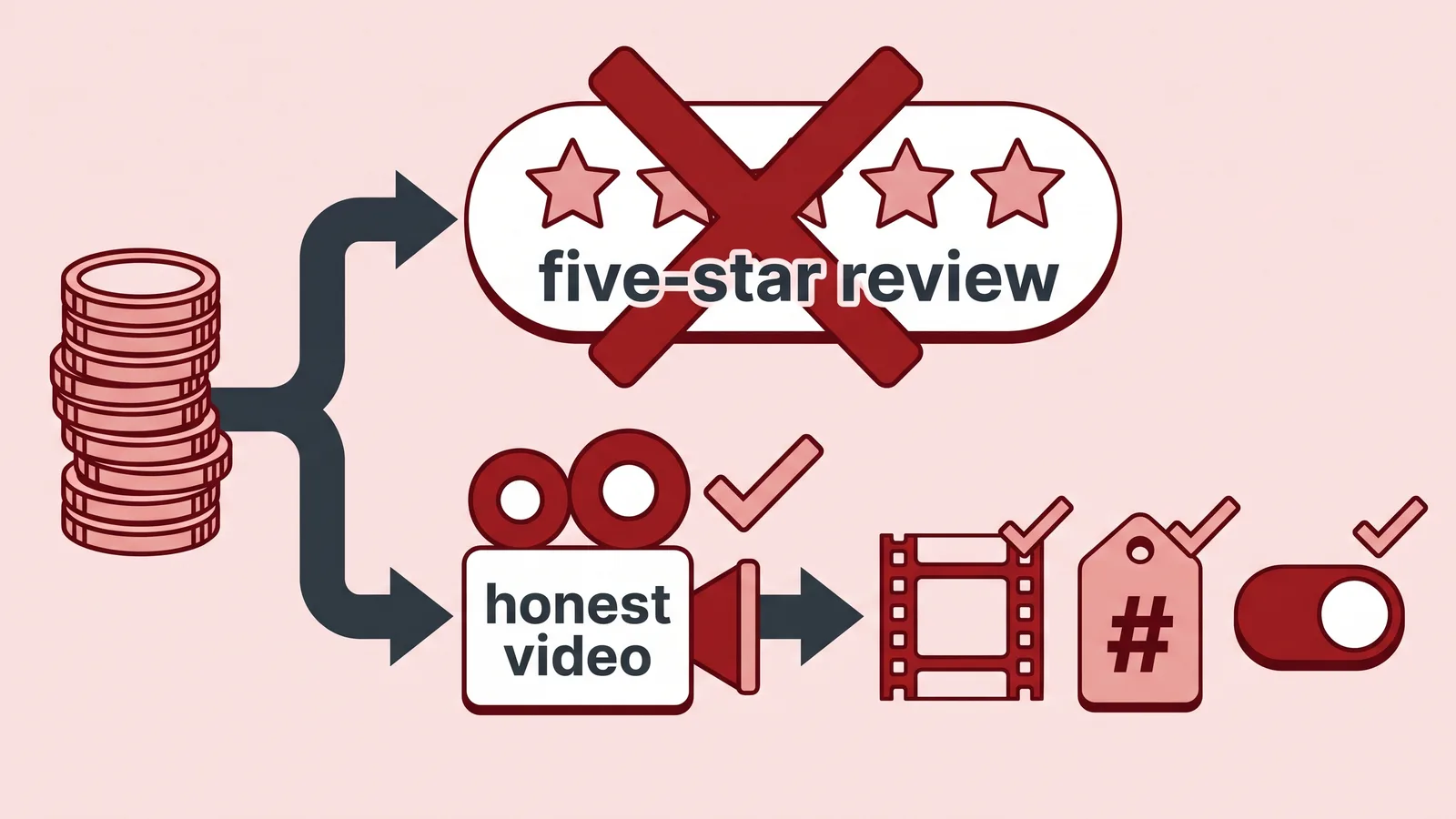
One clause changes how you write briefs. Under the FTC rule, brands may not tie payment or incentives to a creator or customer saying something positive (or negative) about the product — so "we pay on approval of a five-star review" is out, while "we pay for an honest video, whatever you conclude" is fine.
Enforcement is live. The FTC announced warning letters to ten companies over possible Consumer Review Rule violations on December 22, 2025, per Kelley Drye’s Ad Law Access.
Disclosure is the other half. The FTC rewrote its Endorsement Guides FAQ for the first time since 2017, adding 40 new questions with specific guidance for influencers on disclosing material connections across platforms. Put the disclosure in the video, in the caption, and in the platform’s paid-partnership toggle — three places, every time.
This is general information for marketers, not legal advice; run your program past counsel before you scale it.
Common misconceptions about UGC ads
"UGC is free content." Organic posts are free to admire and expensive to use. Licensing, usage windows and whitelisting fees are the normal cost of running someone else’s face in your ad account.
"It has to look bad." Low production value is a side effect, not the goal. Shaky and incomprehensible is still incomprehensible; the clip needs clear audio, a visible product and one idea.
"Any happy customer video can be boosted." Only with permission — on TikTok, that authorization runs through Business Center before the post can be used in ads.
"AI avatar video counts as UGC." It does not. A synthetic presenter is brand-produced content and should be labeled and briefed as such; tools like AI Studios, DeepBrain AI’s platform for AI avatar videos and text-to-video, are useful for scripted explainers and for dubbing a winning concept into other markets — paid plans offer text-to-speech in 150+ languages and accents — but a real person’s testimonial is what makes a UGC ad persuasive.
Bottom line
UGC ads work because the format borrows the credibility of a recommendation and the economics of a phone camera. The platform data supports the format rather than the mythology: TikTok’s Ads Help Center reports Spark Ads deliver CVR +43% and CPM -4% versus non-Spark ads, which is meaningful but not magic.
Build the program around three habits. Brief for honesty and pay for the video, not the verdict. Get written permission and platform authorization before the first impression serves. Disclose in the video, the caption and the paid-partnership tool.
Keep one polished asset for the moments when a buyer is already paying attention. Spend the rest of your creative budget on volume, because the only reliable way to find the winning hook is to run more of them.
Frequently asked questions
Are UGC ads the same as influencer marketing?
No. Influencer marketing buys access to a creator’s audience through their organic reach, while a UGC ad buys the footage and puts your own media budget behind it — often running from the creator’s handle with permission, but targeted and optimized by you.
Do I need written permission to run a customer’s video as an ad?
Yes, both legally and technically. On TikTok, running a UGC video as a Spark Ad requires permission to the account that posted it, granted through Business Center before the post can be used in ads, according to TikTok’s Ads Help Center.
Can I pay a creator more for a positive review?
Not in the United States. Under the FTC’s Rule on the Use of Consumer Reviews and Testimonials, brands may not tie payment or incentives to a creator or customer saying something positive or negative about the product. Pay for the deliverable, not the verdict.
How many UGC ads should I test before judging the format?
Plan for volume rather than a single hero asset: brief several creators, vary the first three seconds, and expect most clips to underperform. TikTok Marketing Science’s Elements of Attention study found showing the product lifted ad recall 138%, so keep the product on screen in every variant.
Does UGC-style creative work outside TikTok?
Yes — vertical feeds on Reels, Shorts and Stories share the same grammar, though the authorization tools and ad formats differ by platform. Check each platform’s official help center for how it licenses organic posts before you promise a client a launch date.
Sources
- Spark Ads in Video Shopping Ads — TikTok Ads Help Center
- TikTok Spark Ads: How They Work, Cost and When to Use Them — Parah Group
- Federal Trade Commission Announces Final Rule Banning Fake Reviews and Testimonials — FTC
- Consumer Protection/FTC Advisory: FTC Issues Final Rule on Fake Reviews and Testimonials — Alston & Bird
- FTC Warns Companies of Potential Violations of the Consumer Review Rule — Kelley Drye Ad Law Access
- Federal Trade Commission Announces Updated Advertising Guides to Combat Deceptive Reviews and Endorsements — FTC
Written with AI assistance and fact-checked against the sources cited above before the AI Marketings Editorial Team published it.