Produce short form video marketing weekly by locking one platform, one publishing day, and one metric, then batch-filming four to six answers to real customer questions in a single two-hour session each month.
Quick steps
Pick the smallest version of this habit you can keep during a bad week. Everything below scales up from that floor, never down.
- Choose one platform and one fixed day. Tuesday Reels or Thursday Shorts — put it in the calendar as a recurring block with a reminder the day before.
- List 20 questions customers already ask you. Each question becomes one video, so you never open a blank document on filming day.
- Book one two-hour filming block per month. Shoot four to six videos back to back in one location, one lighting setup, different shirts.
- Edit once, caption always. Burned-in captions, a spoken hook in the first line, one closing ask per video.
- Review one metric every Monday. Watch-through rate or saves — one number, one decision, five minutes, then close the tab.
If a week falls apart, publish one unedited phone answer to a customer question. A rough video that ships beats a polished one stuck in review.
Why consistency, not polish, beats everything else in short form video marketing
The hard part was never the camera. It is the fourth week, when the novelty is gone, the editor is busy, and nobody internally is asking where the video is.
Short-form distribution rewards repetition. Platforms need multiple uploads to work out who should see your account, and your audience needs several appearances before your face registers as familiar.
In HubSpot’s 2025 State of Marketing data, short-form video was the format most marketers named as delivering the highest ROI, at 21%, with live-streaming video third at 15.53%. That return assumes you keep publishing long enough to collect it.
Polish is expensive in the one currency small teams lack: calendar time. A scripted shoot with an external editor adds approval rounds, feedback threads, and a two-week gap between idea and post.
Rough-but-regular has a second advantage. You learn what your audience responds to across dozens of posts instead of guessing from three.
Set a quality floor instead of a quality ceiling: audible sound, readable captions, a face or product visible in the first second. Anything above that floor is optional.
Step 1 — Pick one platform, one weekly slot, and one measurable goal
Time: 30 minutes. You need: your current analytics, a calendar, and a decision you will not revisit for 90 days.
Choose the platform where your customers already follow accounts like yours, not the one with the best headlines. A home-services business in one town usually finds more buyers on Instagram Reels than on TikTok; a B2B software team often finds them on LinkedIn or YouTube Shorts.
HubSpot research found that 75% of marketers plan to maintain or increase their short-form video investment this year, which means the feed you enter is getting more crowded, not less — another reason to go deep on one surface before widening.
Pick your weekly slot by production reality, not by posting-time folklore. If Monday mornings are chaotic, Thursday at 4 p.m. is a better promise.
Then choose one goal and one matching metric:
- Awareness — views from non-followers.
- Consideration — average watch-through rate.
- Demand — saves, shares, or profile-link clicks.
- Recruitment or trust — comments and follows per post.
Write the platform, the day, and the metric on one line and pin it where the team sees it. That single line is your contract.
Step 2 — Build a 20-idea content bank from questions customers already ask you
Time: 45 minutes. You need: your sales inbox, recent call notes, live-chat transcripts, and your FAQ page.
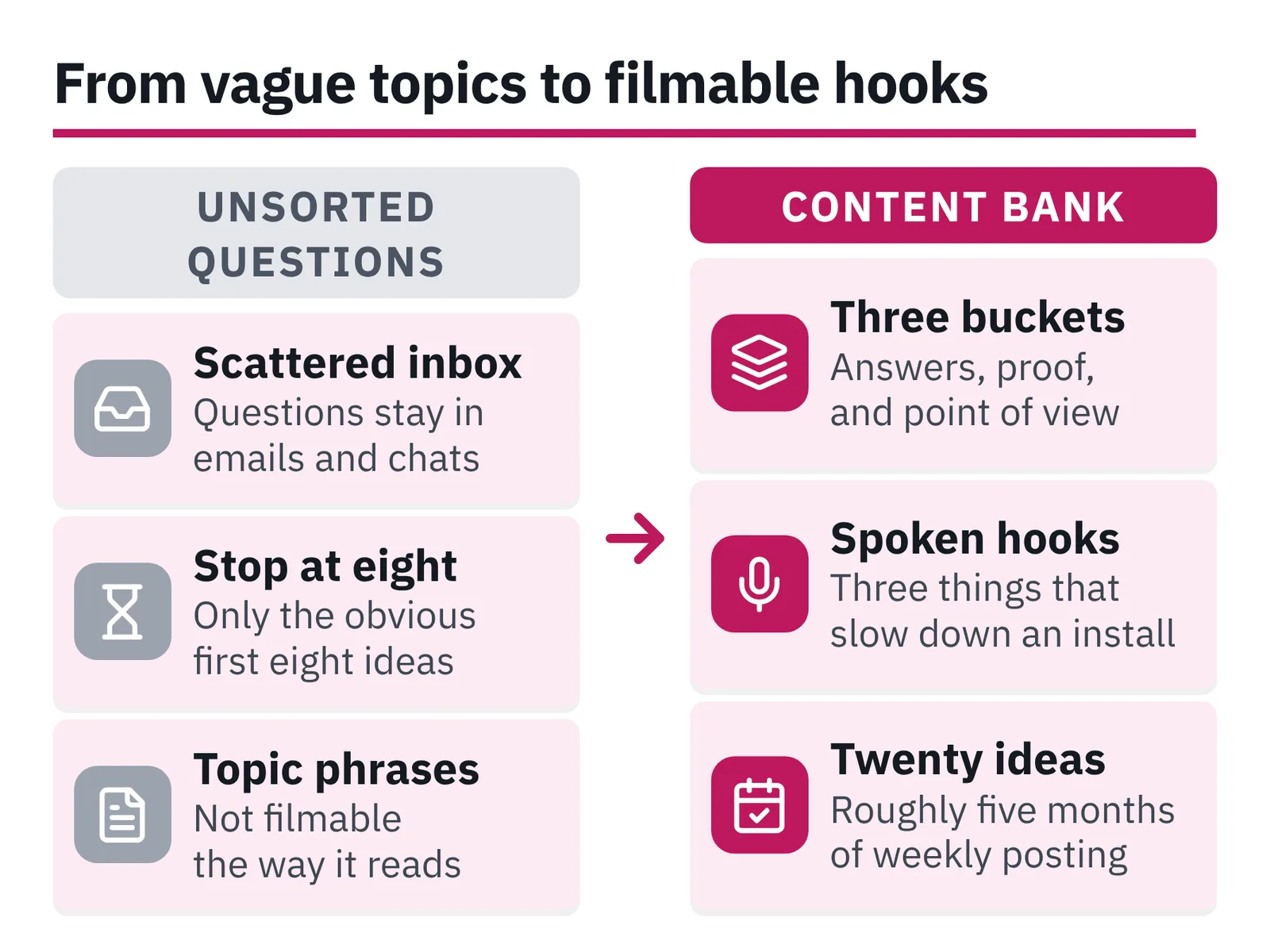
Open the last 30 customer emails and write down every question in plain words. "How long does install take?" is a video. "Do you work with insurance?" is a video.
Aim for 20 before you stop, because the first eight will be obvious and the last twelve are usually the ones that get saved and sent to a colleague.
Wyzowl reports that social media videos are the most commonly produced video type at 69%, just ahead of explainer videos at 68% — and a customer question answered on camera is both at once.
Sort the bank into three buckets so your feed has variety: answers, proof, and point of view. If you want a wider menu of formats to borrow from, the breakdown of which video formats fit which stage of the funnel is a useful checklist.
Give each idea a one-line hook written the way you would say it out loud. "Three things that slow down an install" is filmable. "Installation timeline considerations" is not.
Keep the bank in a shared doc with a status column. Twenty ideas is roughly five months of weekly posting.
Step 3 — Batch-film a month of videos in a single two-hour session
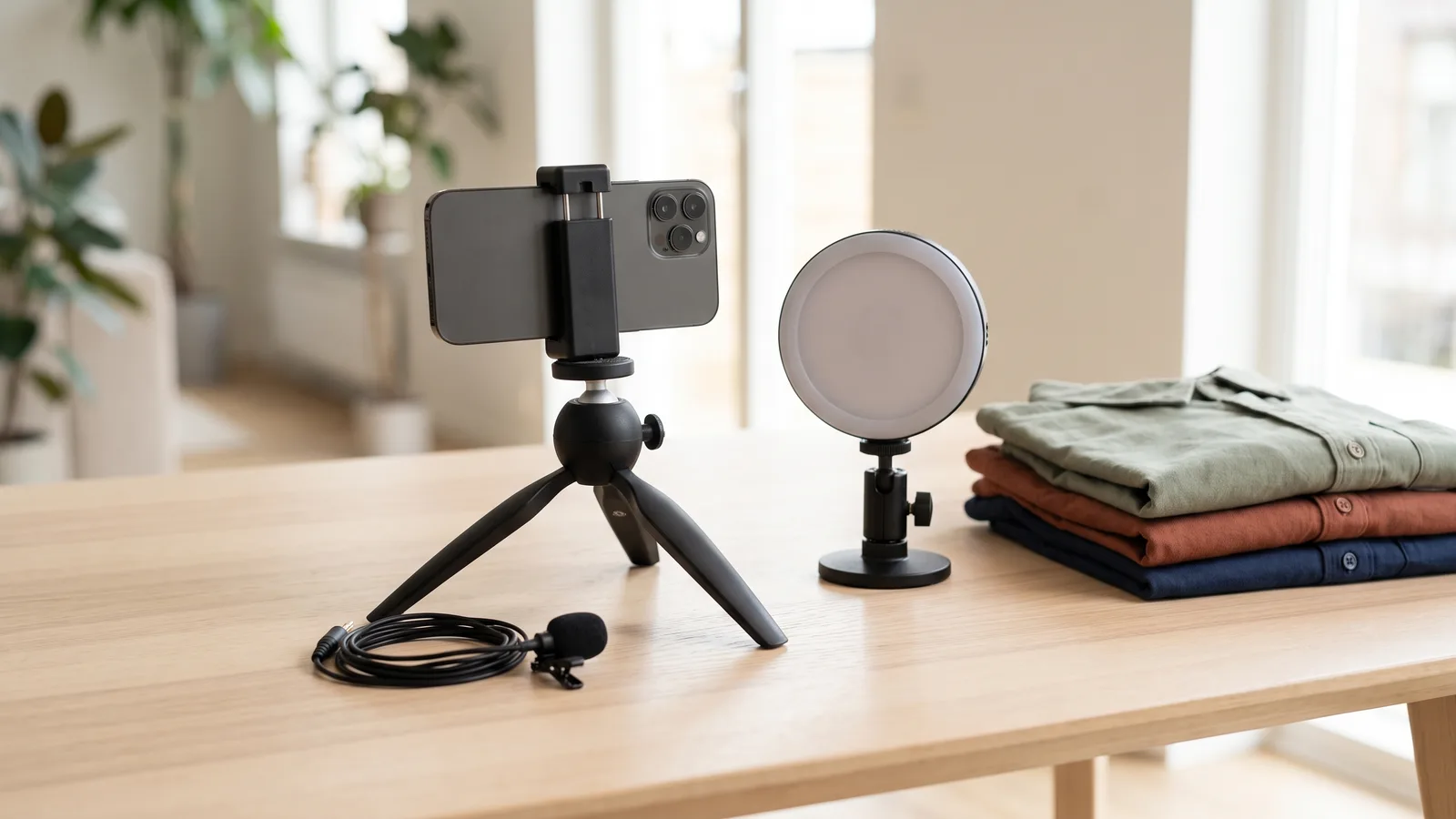
Time: two hours. You need: a phone, a small tripod, a clip-on mic, a window or one LED light, water, and three or four shirts.
Set up once. Film the easiest idea first to warm up, then work down your list, changing shirts every two videos so the feed does not look like one long clip chopped up.
Do not script word for word. Put the hook and three bullet points on a sticky note beside the lens and talk. Two takes maximum, then move on — the third take is almost always worse.
When filming genuinely is not possible — a founder who travels, a regulated industry where every line needs review — an avatar tool can keep the slot filled. AI Studios is DeepBrain AI’s cloud platform for AI avatar videos, text-to-video and video translation, and it can build a video from a script, a topic prompt, a web URL, an uploaded document or a product page. Its free plan costs $0 and allows up to 3 AI videos of up to 1 minute each in 720p, so a weekly habit needs a paid plan. The honest limitation: an avatar cannot show your warehouse, your dentist’s chair, or your hands fixing the thing, so filming still wins for anything physical.
If you are weighing in-house batching against outside help, the comparison of agencies, freelancers and AI for video production lays out the cost and control trade-offs.
Step 4 — Edit once, caption always, and cut to the length each platform rewards
Time: 20 minutes per video. You need: one editing app and one saved template.
Build a template with your caption style, safe margins, and an end card, then reuse it for every video. Re-deciding fonts each week is how a 20-minute edit becomes 90.
Cut the first three seconds hard: no logo sting, no "hey guys", straight into the question. The guide to planning video that hooks in the first three seconds covers hook patterns you can reuse across platforms.
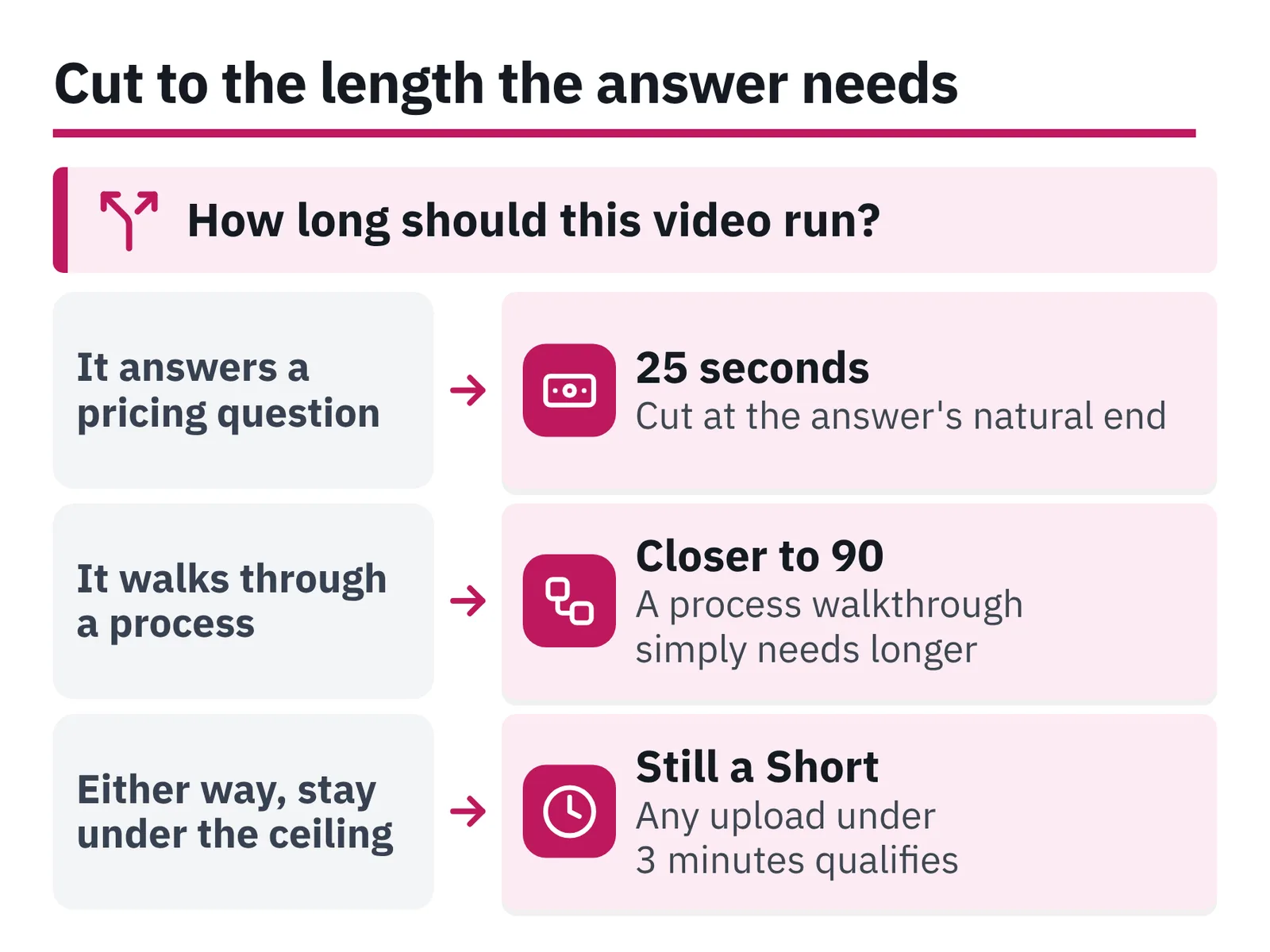
YouTube announced that starting October 15 creators can upload Shorts up to 3 minutes long, and Social Media Today reported that YouTube has since completed the rollout to all users, so any upload under 3 minutes qualifies as a Short. Instagram also expanded recommendations so Reels up to 3 minutes long can be surfaced in Explore and the Reels tab.
Longer ceilings do not mean longer videos. Cut to the natural end of the answer: a pricing question is often 25 seconds, a process walkthrough closer to 90.
Burn captions in rather than relying on auto-captions alone, and read them back once on a phone. Misspelled product names in captions are the most common avoidable error.
Step 5 — Publish, repurpose across platforms, and review one metric each week
Time: 30 minutes weekly. You need: your scheduler, the master exports, and a one-row spreadsheet.
Publish to your chosen platform first, with a written caption that repeats the hook as text for anyone watching on mute. Add two or three topical keywords in plain language rather than a wall of hashtags.
Repurpose on a delay, not simultaneously. The same clip can run on Reels this week, Shorts next week, and inside a customer email the week after — the audiences barely overlap, and the second posting costs you ten minutes. If email is part of your mix, the practical notes on getting video to actually play in an inbox will save you a broken send.
HubSpot’s statistics hub reports that the top three ROI-driving content formats are all video, led by short-form video at 49%, which is the argument you hand your boss when the weekly slot comes under pressure.
Monday review is one metric, one question: did the hook hold attention past the first few seconds? If three videos in a row dipped early, change hooks and keep topics. For shortlists of schedulers and editors built for two-person teams, see the roundup of video tools small teams can actually maintain.
Your weekly short-form video checklist
Print this or paste it into your project tool as a recurring task. The point is that no step requires a decision — decisions were made in Step 1.
- ☐ Monday, 5 minutes. Check last week’s single metric and note the hook that performed best.
- ☐ Monday, 10 minutes. Pull the next idea from the 20-question bank and write its one-line hook.
- ☐ Midweek, 20 minutes. Edit the next video from the batch using your saved template.
- ☐ Midweek, 5 minutes. Proofread burned-in captions on a phone screen, not a desktop.
- ☐ Publishing day. Post in the fixed slot, with the hook repeated in the written caption.
- ☐ Publishing day, 5 minutes. Reply to every comment in the first hour.
- ☐ Monthly. Book the two-hour batch session and refill the idea bank back to 20.
Total weekly time once the batch is filmed: under an hour. That is the number to defend when someone suggests a quarterly brand film instead.
Keep the checklist visible to whoever covers for you during holidays. A habit that only one person can run is not a system.
Common mistakes that kill a weekly video habit, and how to fix them
The failure that ends most programs is posting to three platforms at once in week one. Three feeds mean three caption styles, three comment threads, and three sets of analytics — fix it by muting two platforms for 90 days and archiving, not deleting, the extra accounts.
Filming one video at a time is the second killer. Setup and teardown cost the same for one video as for six, so a single-video session feels like poor value and quietly gets skipped.
Waiting for approval on every script is the third. Agree on a standing guardrail list — no pricing promises, no competitor names, no claims about results — and let the person filming publish inside those lines.
Chasing trending audio you do not understand wastes the slot. A clear answer to a customer question ages better than a meme that dies on Thursday.
Quitting after four weeks because nothing happened is the most expensive mistake of all. Wyzowl’s latest video marketing statistics are based on a survey of 266 unique respondents carried out in late 2025, and the firms reporting results from video are generally the ones still publishing after the quiet months.
When motivation drops, lower the production bar rather than the frequency. One unedited answer filmed in a parking lot keeps the streak and the algorithm’s attention.
Frequently asked questions
How long should a short-form video be in 2026?
Cut to the natural end of your answer, usually 25 to 90 seconds. The ceilings are higher than that: YouTube announced that creators can upload Shorts up to 3 minutes long, and Instagram expanded recommendations so Reels up to 3 minutes can surface in Explore and the Reels tab.
How many videos per week do I actually need to post?
One per week, published reliably, beats four for a month and then silence. A single two-hour monthly batch covers four to six videos, which gives you a buffer for sick weeks, holidays, and the weeks your main client emergency eats everything.
Can one person run this without a videographer or editor?
Yes, with a phone, a tripod, a clip-on mic and one saved editing template. Budget roughly two hours per month for filming and about 20 minutes per video for editing and captioning, which is under an hour of weekly work once the batch exists.
Is it worth posting the same clip on more than one platform?
Usually yes, on a delay rather than at the same moment, because follower overlap between platforms is small and the second upload costs about ten minutes. Change the written caption and remove any on-screen reference to the original platform before reposting.
What metric should a small team track each week?
Track one: average watch-through rate if you want better hooks, or saves and profile clicks if you want demand. HubSpot’s statistics hub reports that the top three ROI-driving content formats are all video, led by short-form video at 49%, so one honest number is enough to justify the slot.
Sources
- Tall updates coming to Shorts – YouTube Blog
- YouTube Expands 3-Minute Shorts to All Users — Social Media Today
- Instagram Now Recommends Longer Reels in Explore: What Creators Need to Know — Social News Desk
- 45 Video Marketing Statistics for 2025 [New Data] — HubSpot
- 2026 Marketing Statistics, Trends, & Data — HubSpot
- The Psychology of Short-Form Content: Why We Love Bite-Sized Videos — HubSpot
- Video Marketing Statistics 2026 (12 Years of Data) — Wyzowl
Written with AI assistance and fact-checked against the sources cited above before the AI Marketings Editorial Team published it.